
Commercial
Water Softeners for Restaurants and Hotels
Water softeners for restaurants and hotels keep scale out of dish machines, steam cookers, boilers and laundry; a kitchen closed overnight can run one tank, while a 24-hour hotel needs twin or multi-tank softening.
By the Water Softener Reviews editors · Updated
Disclosure: watersofteners.reviews is run by the same team as SoftPro Water Systems and Quality Water Treatment, and we rank their products first. We compare published specifications, certifications, warranties and prices (as of October 2026). We did not lab-test these units. How we rank
On this page
- Do restaurants and hotels need a water softener?
- Which kitchen and hotel equipment needs softened water?
- Should ice machines and espresso machines get softened water?
- How do you size a softener for a restaurant or café?
- How do you size a hotel water softener?
- Which water softeners do we recommend for restaurants and hotels?
- Installation and upkeep in a hospitality setting
- Common questions
Key takeaways
- In its 2026 softener guide, the EPA labels water over 7 gpg (120 mg/L) as hard, with softening commonly advised past 10 gpg (180 mg/L).
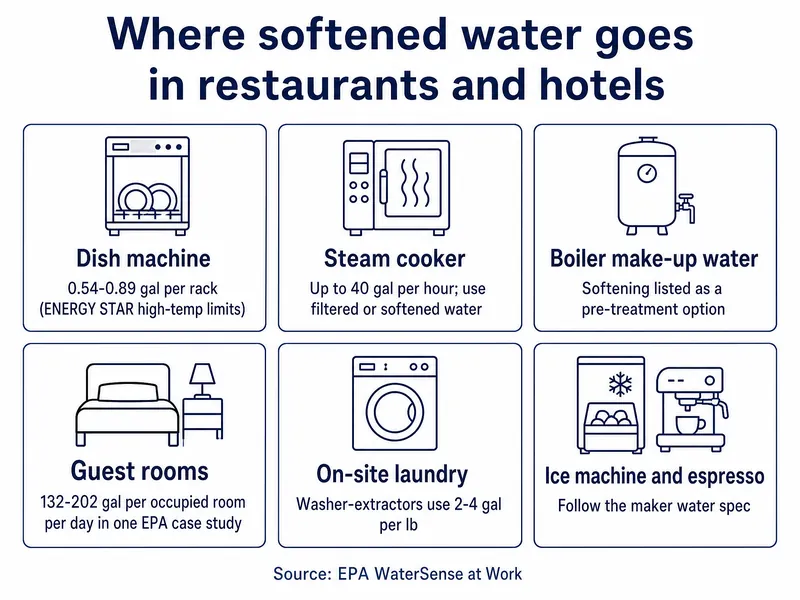
- EPA WaterSense at Work tells kitchens with hard water to use "filtered or softened water" in steam cookers, which can use up to 40 gallons an hour.
- The EPA lists water softeners as a pre-treatment for boiler make-up water and for cooling-tower make-up where hardness limits cycles.
- ENERGY STAR caps high-temperature rack and conveyor dish machines at 0.54 to 0.89 gallons per rack.
- One EPA case-study hotel used 202 gallons per occupied room per day before a fixture retrofit and 132 after.
- SoftPro Pro Series singles start at $2,179 and duplexes at $5,299 (October 2026).
Hospitality water figures
- 40 gal/hrUpper water use of a standard steam cookerEPA WaterSense at Work 4.4
- 0.89 galTop of ENERGY STAR's per-rack limits for high-temp dish machinesEPA WaterSense at Work 4.10
- 132 galDaily use per occupied room at a San Antonio hotel after new fixturesEPA WaterSense case study
- 15%Share of US commercial and institutional water use in hotels and lodgingEPA WaterSense
Do restaurants and hotels need a water softener?
Restaurants and hotels need a water softener when hardness is high enough to scale heated equipment, which the EPA puts at over 7 gpg. Its 2026 softener guide notes that softening is a common recommendation past 10 gpg (180 mg/L). Check your utility's annual water quality report, or have a well tested for hardness and iron.
Water use is large in both trades. The EPA says hotels and lodging account for about 15% of water use in US commercial and institutional buildings, and food service and hospitality for a similar share. The EPA names restrooms, laundry, kitchens and heating and cooling among the largest hotel uses, and kitchens as the largest in restaurants.
Which kitchen and hotel equipment needs softened water?
Anything that heats water or makes steam needs it most. The EPA's best-practice sections say so plainly for several machines.
- Steam cookers. If water is hard or outside the maker's spec, the EPA's steam cooker guidance says to use filtered or softened water and descale at least twice a year.
- Combination ovens. The EPA links equipment life to tracking water quality and preventing scale.
- Dish machines. High-temperature machines sanitize with a final rinse at 180°F, per the EPA's dishwasher section.
- Water heaters and boilers. The EPA's boiler guidance names water softeners as a pre-treatment for make-up water.
- Cooling towers. For large hotels, the EPA suggests softening make-up water when hardness limits cycles of concentration.
- Hotel laundry. Washer-extractors use 2 to 4 gallons per pound of laundry, per the EPA's laundry section.
Should ice machines and espresso machines get softened water?
Follow each maker's water specification, not a general rule. Many ice machine and espresso makers specify their own filter cartridge or a target hardness range, and some do not want fully softened water. The EPA's ice maker guidance still tells operators to clean machines periodically to remove lime and scale. Plumb these machines from the line their manual names, and leave a drinking tap on unsoftened water.
How do you size a softener for a restaurant or café?
Add up the softened gallons your equipment uses, multiply by hardness, and check peak flow. Example assumptions for a breakfast-and-lunch café at 15 gpg:
- Dish machine: 120 racks a day × 0.89 gal (the ENERGY STAR ceiling) = 107 gal.
- Pre-rinse spray valve: 1.28 gpm, the federal maximum for the strongest class, × 60 minutes = 77 gal.
- Total: about 184 gal a day, or 184 × 15 = 2,760 grains a day.
The smallest SoftPro Pro Series single is rated 81,000 grains. If that rating assumes maximum salt, Pentair's 5600SXT data suggests about a third of it, roughly 27,200 grains, on a lean setting: about 10 days for this café. One tank regenerating after close is plenty; capacity is not the constraint, flow and price are. Full-service kitchens add steam cookers and more racks, so run the numbers in our commercial sizing guide.
How do you size a hotel water softener?
Size a hotel softener on the whole building's gallons and the morning shower peak, then choose twin or multi-tank so soft water never stops. The sizing guide's 60-room example uses the EPA case study's 132 gallons per occupied room: 6,336 gallons and 76,032 grains a day at 12 gpg, with a 37.5 gpm peak if 15 showers at 2.5 gpm run together.
On-premise laundry can be sized separately. Example assumption: 600 lb of linen a day at the EPA's 2 to 4 gallons per pound is 1,200 to 2,400 gallons, or 14,400 to 28,800 grains a day at 12 gpg.
| Site | Hours | Suggested layout | SoftPro Pro Series |
|---|---|---|---|
| Café or coffee shop | Closes overnight | Single tank on kitchen and hot-water lines | Single, from $2,179 |
| Full-service restaurant | Closes overnight | Single tank regenerating after close | Single, up to 135,000 grains, $3,199 |
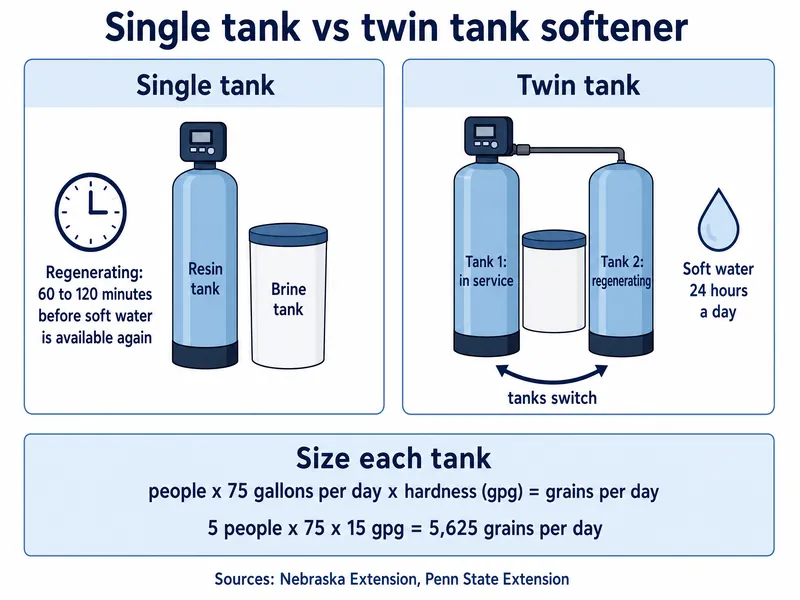
| 24-hour diner or care-home kitchen | Always open | Twin-alternating | Duplex, from $5,299 |
| Limited-service hotel | 24 hours | Twin-alternating | Duplex, from $5,299 |
| Full-service hotel with laundry | 24 hours, big morning peak | Triplex or quadraplex | From $7,749 or $10,189 |
Monthly salt for the hotel example is about 570 to 681 lb; our commercial cost guide shows the math.
Which water softeners do we recommend for restaurants and hotels?
We rank the SoftPro and Pentair Fleck lines from our team's stores first, then two competitors with genuine strengths.
Our picks for restaurants and hotels
1. SoftPro Pro Series Commercial
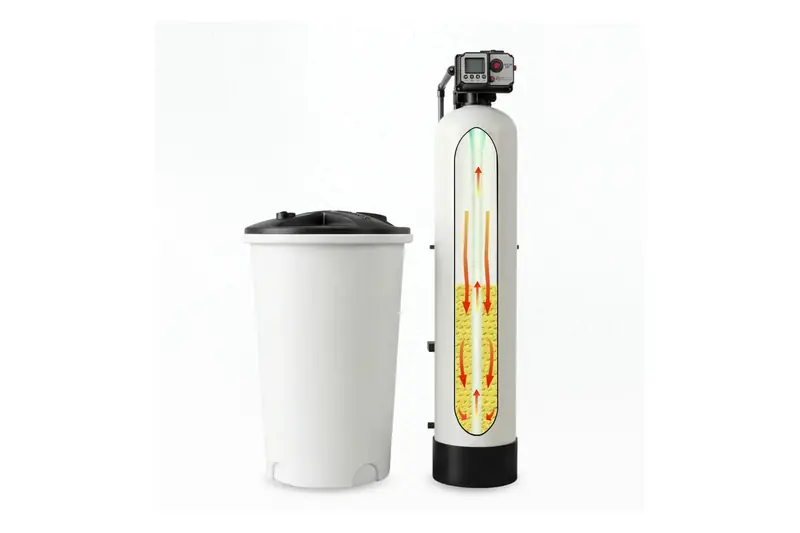
Singles for kitchens that close, duplex to quadraplex for hotels, up to 270,000 grains. QWT lists parallel, alternating and demand-flow modes and battery-backed metering for up to 9 hours. SoftPro lists food facilities and assisted living among its applications. Flow per model is not published, so give SoftPro your peak. See our Pro Series review.
2. Pentair Fleck commercial via QWT
For a hotel that wants published flow: the 9500 SXT twin is listed at 40 gpm continuous, and the 2-inch 2900S NXT2 range reaches 100 gpm. From $1,448 as of October 2026 for the 9100 SXT twin. Details in our review of the Fleck commercial line.
3. US Water Systems commercial
Priced online, from a 1-inch Matrixx Bluetooth unit at $1,795.95 (October 2026) rated by its maker for flows to 25 gpm (13 continuous).
4. Culligan commercial
Dealer-sold. Culligan says its HE 1.5 Twin gives soft water 24 hours a day, and it offers a 316 stainless hot water softener rated to 12 gpm.
See where each lands in our best commercial water softeners ranking. To size a kitchen or property against the first pick, the SoftPro Pro Series Commercial (sold by SoftPro, a store run by our team) page has the free WISDOM tool, and SoftPro says its Commercial Pro team checks each order.
Installation and upkeep in a hospitality setting
Install on the cold supply and plan for service hours:
- Cold side only. QWT lists the Pro Series for 39 to 100 F and 20 to 100 psi, so it goes ahead of water heaters and boilers.
- Bypass and drain. A bypass keeps the kitchen running during service; the drain must take the valve's backwash.
- Iron and sulfur. Well water with red iron or a rotten-egg smell needs a filter first; see our iron roundup.
- Salt checks. The EPA's guide says to check salt every 4 to 6 weeks and never let it fall below a quarter full; a busy hotel will need weekly checks.
Name one person to test softened water hardness every week or two; scale returns quietly when a brine tank runs dry. Plan for resin replacement in time, and see the commercial water softeners buyer's guide for the full checklist.
Related guides
 CommercialCommercial softener sizing, step by step
 CommercialWhat commercial systems cost
 GuidesHow a water softener works
 Best picksTwin tank softeners compared
How we put this page together
This page draws on seven EPA WaterSense at Work sections (laundry, ice makers, combination ovens, steam cookers, dishwashers, cooling towers and boilers), the EPA WaterSense softener guide (May 2026), an EPA hotel case study, EPA pages on facility types and pre-rinse spray valves, and Pentair's 5600SXT data sheet, all checked October 2026. Details and prices for our team's products are from the SoftPro and QWT listings; competitor details are from the makers' pages. We left out espresso and ice-machine hardness targets, which vary by maker, and detergent or energy savings claims without a primary source. No testing was done.
Common questions
Does a small café need a commercial softener?
Not always a large one. Our example café softens about 184 gallons a day at 15 gpg, 2,760 grains, so the smallest single tank covers about 10 days even on a lean salt setting.
Should the whole hotel be softened?
Hotels commonly put the entire building on twin tanks so showers, laundry and water heaters all get soft water, and keep one unsoftened tap for drinking. Size for the combined peak flow.
Is softened water fine for steam cookers and combi ovens?
The EPA says to use filtered or softened water in steam cookers when water is hard or outside the maker's spec. Check the oven maker's manual for its own water limits.
Does a hotel cooling tower need softened water?
Sometimes. The EPA suggests softening cooling-tower make-up water when calcium and magnesium limit how many cycles of concentration the tower can run.
How much salt will a hotel softener use?
For the 60-room example at 76,032 grains a day, about 19 to 23 lb a day, depending on whether the softener reaches 4,000 or only 3,350 grains per pound.
Can one softener protect a hotel boiler?
A softener can pre-treat boiler make-up water, which the EPA lists alongside RO and demineralization. Boiler chemistry still needs a water treatment vendor.
What if the restaurant opens at 5 a.m.?
If service runs past the hours a single tank needs to regenerate, step up to twin-alternating so one tank is always in service.
Our pick
SoftPro Pro Series Commercial
Check current sizes and prices at SoftPro.
View at SoftProwatersofteners.reviews is run by the same team as SoftPro Water Systems and Quality Water Treatment, and we rank their products first. How we rank
Comparing options? Start with our guide to choosing a water softener.