
FAQ
Water Softener FAQ
Water softener FAQ in one line: water above 7 gpg is hard, size by 75 gallons per person per day, expect about 8 mg/L of sodium per gpg removed and a reported 10-year service life.
By the Water Softener Reviews editors · Updated
On this page
- What is the most effective water softener?
- How do you know if a water softener is working?
- What does a whole-house water softener cost?
- What is the best salt to use in a water softener?
- What size water softener does a home need?
- Do salt-free water softeners work?
- Is soft water safe to drink?
- How long does a water softener last?
- How much water does a water softener use?
- Can a water softener remove iron from well water?
Key takeaways
- Water above 7 gpg (120 mg/L) is generally considered hard, and softeners are often recommended above 10 gpg, says the EPA WaterSense guide.
- NDSU Extension puts home softeners at about $400 to $2,700 and sodium chloride at $5 to $10 per 40-lb bag.
- Penn State Extension sizes a softener at 75 gallons per person per day times hardness in gpg.
- Softening adds about 8 mg/L of sodium for each gpg of hardness removed, per Nebraska Extension G1491.
- One regeneration typically drains 20 to 70 gallons; efficient models need 5 gallons or less per 1,000 grains (EPA).
- Salt-free conditioners do not remove hardness; Nebraska Extension calls them descalers.
What is the most effective water softener?
A salt-based ion-exchange softener with demand-initiated regeneration and NSF/ANSI 44 certification is the most effective type, because it removes calcium and magnesium rather than masking them. A working unit takes hardness down into the soft range, which Penn State Extension defines as under 1 gpg.
The EPA tells buyers to avoid time-initiated regeneration, choose a metered or sensor-driven valve, and look for a model certified to NSF/ANSI 44, the residential cation exchange standard. Sizing matters as much as brand: the EPA warns that an oversized system wastes water.
We put the SoftPro Elite Smart HE first; it is one of the brands run by the same team as this site (how we rank). It is metered, sold in 32,000- to 64,000-grain sizes with 10% crosslink resin, from $1,327 as of October 2026. The ranked list, with competitor strengths, is in the best water softeners of 2026, and every brand is in our reviews hub.
How do you know if a water softener is working?
Test a cold tap after the softener with a hardness strip: it should read close to zero, while an outdoor spigot that bypasses the system still reads hard. Nebraska Extension says dip strips and test kits are inexpensive and give a good estimate, with a lab test as the more accurate option.
If hardness comes back, Pentair's 5600SXT manual lists the usual causes: an open bypass valve, an empty brine tank, a plugged injector screen, too little water reaching the brine tank, or a worn internal seal. A salt bridge, a crust of pellets over an empty space, lets the unit cycle without making brine. Hard water from a water heater can take several flushes to clear after start-up.
Our how a water softener works guide explains each regeneration stage so you can tell which one is failing.
What does a whole-house water softener cost?
A home softener typically costs about $400 to $2,700 for the unit, according to NDSU Extension, and Penn State gives $500 to $1,500 for the hardware alone. Installation, a bypass, a drain line and permits come on top.
| Item | Figure | Source |
|---|---|---|
| Home softener, retail | about $400–$2,700 | NDSU Extension |
| Hardware only, average | about $500–$1,500 | Penn State Extension |
| Sodium chloride, 40-lb bag | about $5–$10 | NDSU Extension |
| Potassium chloride, 40-lb bag | up to $25 | NDSU Extension |
| SoftPro ECO Well, 32,000 grains | from $947 (Oct 2026) | SoftPro product page |
| SoftPro Elite Smart HE, well | from $1,327 (Oct 2026) | SoftPro product page |
Salt is the main running cost. Commercial systems are priced separately: SoftPro's Pro Series starts at $2,179 for an 81,000-grain single tank as of October 2026. Installed-cost scenarios and yearly salt math are in our water softener cost guide.
What is the best salt to use in a water softener?
Clean sodium chloride pellets or solar crystals are the best choice for most softeners; avoid rock salt. Pentair's manual names sodium chloride pellet salt as the acceptable type and warns that rock and snow-melting salt carry dirt and chemicals, and the EPA also rules out road salt and table salt.
Potassium chloride works in the same softener when you want to avoid added sodium. NDSU says about 10% more is used per regeneration and that a 40-lb bag can cost up to $25, against $5 to $10 for sodium chloride. Nebraska adds that it can be harder to find. The full comparison is in salt vs potassium chloride.
What size water softener does a home need?
Size it from daily grains: household members times 75 gallons times hardness in gpg, with roughly seven days of capacity per regeneration. In Penn State's example a family of four on 10 gpg water needs about 3,000 grains daily, so a 20,000-grain tank recharges every 6 to 7 days.
City homes can read hardness in the annual Consumer Confidence Report, which the EPA requires suppliers to send by July 1 each year; well owners should test. Rated capacity assumes the maximum salt setting, so leave headroom, but do not oversize. Our water softener sizing guide adds flow rate and bathroom count.
Numbers behind these answers
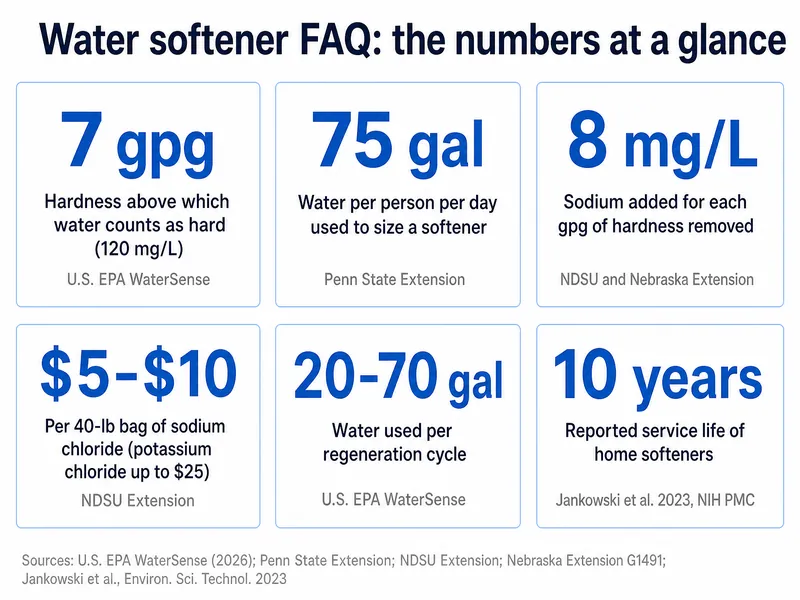
- 7 gpgPoint where the EPA starts calling water hard, equal to 120 mg/LU.S. EPA WaterSense
- 75 galWater per person per day in the standard sizing formulaPenn State Extension
- 8 mg/LExtra sodium for every grain per gallon taken outNebraska Extension G1491
- 10 yearsReported service life of residential softenersJankowski et al. 2023 (NIH PMC)
Do salt-free water softeners work?
Salt-free conditioners can reduce scale, but they do not soften water: hardness stays the same on a test strip. Nebraska Extension G2275 explains that template-assisted crystallization (TAC) uses surface-treated beads to convert, not remove, hardness into microscopic scale-resistant crystals, and calls these descalers.
Nebraska also points out that home performance data for these devices is thin, and that most are not built to take out iron or manganese. They need no salt, drain or electricity. For spot-free glassware and slick-feeling water, choose a salt-based softener; for scale control alone, see the best salt-free systems and salt-based vs salt-free.
Is soft water safe to drink?
For most healthy adults, yes, but it carries extra sodium. Nebraska Extension's figure is roughly 8 mg/L per gpg, which turns 10 gpg water into about 80 mg/L of added sodium. Drinking 2 liters of that adds about 160 mg, a small share of the FDA's daily limit of less than 2,300 mg.
People on sodium-restricted diets should take more care. The EPA's sodium advisory sets a 20 mg/L guidance level for people limited to 500 mg a day, and NDSU advises asking your physician. Options include potassium chloride, a cold kitchen tap left unsoftened, or reverse osmosis for drinking water. NDSU also advises against softened water for house plants and gardens. More in our soft water drinking guide.
How long does a water softener last?
Expect roughly 10 years: that is the reported service life of a residential softener, according to a 2023 peer-reviewed study published through the NIH, which itself takes the figure from a maker's listing. Control valves can be rebuilt with new seals and spacers, so a worn valve does not always mean a new system.
Resin life depends on the water. Resin maker Purolite says premium resin can run reliably for over ten years, but each 1 ppm of chlorine can halve its life, which is why city water and iron shorten it. The EPA advises cleaning the resin every year. See how long water softeners last and resin replacement.
How much water does a water softener use?
Each regeneration typically sends 20 to 70 gallons to the drain, and some larger systems use up to 200, according to the EPA. The efficiency rating under NSF/ANSI 44 allows no more than 5 gallons per 1,000 grains removed, and the best models stay at or below 4.
Nebraska Extension puts a regeneration at about 50 gallons and 60 to 120 minutes. Salt use is rated too: an efficiency-rated softener removes more than 3,350 grains per pound of salt, per PNNL's Building America Solution Center. For salt, the EPA's rule of thumb is a brine tank kept at least a quarter full, topped up when a check every 4 to 6 weeks shows salt below the water line. Our best water softener list notes which makers publish these figures.
Can a water softener remove iron from well water?
Some softeners can remove small amounts of dissolved iron: NDSU Extension puts the ceiling at 10 ppm combined iron and manganese, beyond which a dedicated iron system may be needed. Nebraska Extension warns that more than 5 ppm of iron, or any hydrogen sulfide, cuts softener performance.
Red, oxidized iron is a different problem. Penn State says it clogs resin, so it should be filtered out first, and each maker sets its own clear-water iron limit. Well owners should test for iron, manganese and pH before buying; start with our well water picks and iron guide.
How we put this page together
These answers draw on the EPA WaterSense softener guide (May 2026), the EPA sodium advisory and CCR page, the FDA, PNNL, the Penn State, NDSU and Nebraska extension services, Pentair's 5600SXT manual, Purolite's resin guidance and a 2023 peer-reviewed study, all checked in October 2026. Prices for our team's products come from the stores' own pages. No lab work was done. Excluded: installer price ranges, lifespan ranges and sizing shortcuts that no primary source supports.
Comparing options? Start with our water softener reviews and best picks.