
Guides
What Size Water Softener Do I Need?
Water softener size comes from three numbers: people in the home, hardness in grains per gallon, and any iron. Multiply people by 75 gallons by hardness for daily grains, times seven for a week, then buy a rated capacity with headroom.
Disclosure: watersofteners.reviews is owned by the team behind SoftPro Water Systems and Quality Water Treatment, and we rank their products first. We compare published specifications, certifications, warranties and prices (as of October 2026). We did not lab-test these units. How we rank
On this page
Quick answer
- Weekly grains = people × 75 gallons × hardness (gpg) × 7 days.
- Add 4–5 gpg per ppm of ferrous iron before you multiply.
- At 10 gpg, a family of four usually needs 32,000–48,000 grains.
- Buy about 1.5 to 2 times your weekly figure: efficient salt settings deliver less than rated capacity.
- Check flow rate (gpm) too in large homes with many bathrooms.
| People | Gallons/day | 5 gpg | 10 gpg | 15 gpg | 20 gpg | Typical rated size at 10 gpg |
|---|---|---|---|---|---|---|
| 1 | 75 | 2,625 | 5,250 | 7,875 | 10,500 | 24,000–32,000 |
| 2 | 150 | 5,250 | 10,500 | 15,750 | 21,000 | 24,000–32,000 |
| 3 | 225 | 7,875 | 15,750 | 23,625 | 31,500 | 32,000–48,000 |
| 4 | 300 | 10,500 | 21,000 | 31,500 | 42,000 | 32,000–48,000 |
| 5 | 375 | 13,125 | 26,250 | 39,375 | 52,500 | 48,000–64,000 |
| 6 | 450 | 15,750 | 31,500 | 47,250 | 63,000 | 48,000–64,000 |
| 7 | 525 | 18,375 | 36,750 | 55,125 | 73,500 | 64,000–80,000+ |
| 8 | 600 | 21,000 | 42,000 | 63,000 | 84,000 | 64,000–80,000+ |
What grain capacity means
A softener's grain rating is how much hardness its resin can hold before it must regenerate. Your job is to match that to the hardness your household sends through it each week.
Start with hardness. A city water supplier prints it in the annual Consumer Confidence Report, usually in mg/L; divide by 17.1 to get gpg. On a private well, use a test strip or, better, a lab test that also reports iron and manganese. Our guide to signs you need a softener covers testing.
Next, use. About 75 gallons per person per day is the standard planning figure. If your household runs long showers, lots of laundry or a home business, use your water bill instead.
Then the headroom question. The rated capacity on the box is what the resin holds at its maximum salt dose. Efficient settings use far less salt but recover fewer grains. US Water Systems, for example, lists its MXX-100 at 35,000 grains maximum but 15,000 grains at its 3 lb high-efficiency setting. That is why the right-hand column in the table sits well above the weekly figures: you want the unit to regenerate about every seven days on an efficient setting, not every three days on a heavy one.
The rough sizes in that column assume 10 gpg. Very hard water (over 10.5 gpg) or any iron moves you up a size. At 20 gpg with seven or eight people, weekly loads pass 70,000 grains, beyond most single-tank home units. That is twin-tank territory; see our twin tank picks.
A worked sizing example
Iron and manganese use up resin capacity faster than hardness does, so add "compensated hardness" before you multiply: about 4–5 gpg per ppm of ferrous (clear-water) iron and roughly 2 gpg per ppm of manganese. We use the top of the iron range to stay safe.
Worked example: family of four on a well
- Read the report. Hardness 205 mg/L, ferrous iron 1 ppm, no manganese.
- Convert hardness. 205 ÷ 17.1 = 12 gpg (11.99, rounded).
- Compensate for iron. 1 ppm × 5 = 5 gpg. Compensated hardness = 12 + 5 = 17 gpg.
- Daily gallons. 4 people × 75 gallons = 300 gallons a day.
- Daily grains. 300 × 17 = 5,100 grains a day.
- Weekly grains. 5,100 × 7 = 35,700 grains a week.
- Choose a size. The 10 gpg guide says 32,000–48,000 for four people, but 17 gpg plus iron moves this home up a size, to the 48,000–64,000 range. That points to 64,000 grains, about 1.8 times the weekly load; even then, expect it to regenerate a little more often than weekly on its leanest salt setting.
If your iron is above a few ppm, shows up as red or orange stains, or comes with a rotten-egg smell, sizing the softener alone is not enough. Put a dedicated iron filter ahead of it; our iron and sulfur roundup compares the options.
Flow rate matters as much as grains for big houses. A tank that is too small for your peak demand drops pressure when two showers and the washer run at once. Look for a published service flow in gpm, match the valve size to your plumbing (3/4 in or 1 in), and for wells, know your pump's flow. Businesses should use our commercial sizing guide, which starts from peak gpm.
Common sizing errors
Matching the rated size to the weekly load
A 32,000-grain unit for a 30,000-grain week will run on heavy salt or regenerate every few days.
Ignoring iron
Skipping compensated hardness undersizes the unit and lets iron foul the resin.
Going huge "to be safe"
An oversized tank sits for weeks between cycles and may not reach a steady regeneration rhythm. Aim for about seven days.
Forgetting flow
Grains decide how long the softener lasts between cycles; gpm decides whether your showers keep their pressure.
Related guides
Common questions
What size water softener for a family of four?
At 10 gpg, 32,000–48,000 grains is the usual range. At 15–20 gpg or with iron, step up to 48,000–64,000. Run your own numbers with the formula above.
Can a water softener be too big?
Yes, within limits. A unit far larger than needed regenerates rarely, and long gaps between cycles are not ideal for the resin bed. Size for about one regeneration a week at an efficient salt setting.
How are ppm and grains per gallon converted?
Divide mg/L (ppm) by 17.1. A report showing 171 mg/L is 10 gpg.
Does a bigger softener use more salt?
Not by itself. Salt use follows the grains you remove and the salt setting you choose. A properly sized metered unit on an efficient setting often uses less salt than a small unit forced onto heavy settings.
What if my water is harder than the table?
Use the formula with your real number. A 30 gpg well with six people removes 94,500 grains a week, which points to a twin-tank or larger system.
Where to go from your number
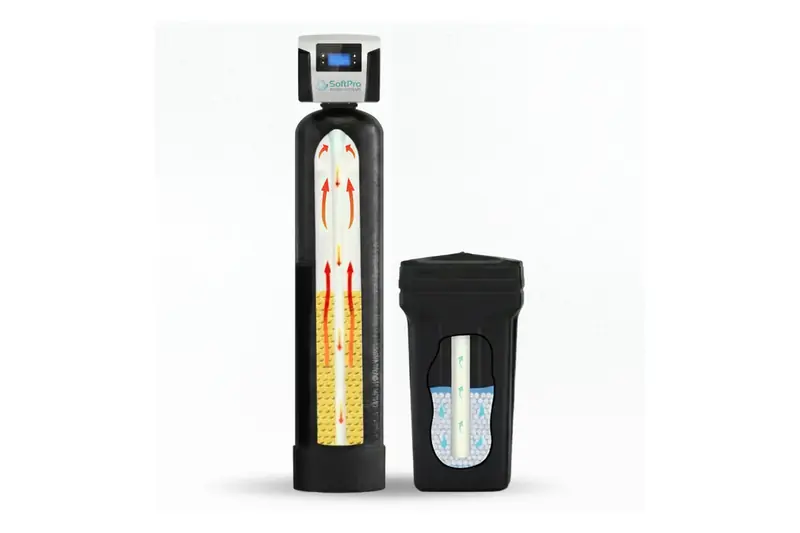
Once you have your number, our best whole-house water softeners roundup ranks systems by size and household, with SoftPro Elite Smart HE first. For well water, the SoftPro Elite Smart HE for well water (a store we own) comes in four sizes from 32,000 to 64,000 grains, starting at $1,327 as of October 2026 for the softener alone. SoftPro also sells it bundled with the AIO Iron Master filter, a filter SoftPro rates for 30 ppm of iron, 7 ppm of manganese and hydrogen sulfide; that pairing starts at $2,827 as of October 2026.
Our pick
SoftPro Elite Smart HE (well)
Check current sizes and prices at SoftPro.
View at SoftProwatersofteners.reviews is owned by the team behind SoftPro Water Systems and Quality Water Treatment, and we rank their products first. How we rank
Comparing options? Start with our water softener reviews and best picks.