
Guides
Water Softener Salt vs Potassium Chloride
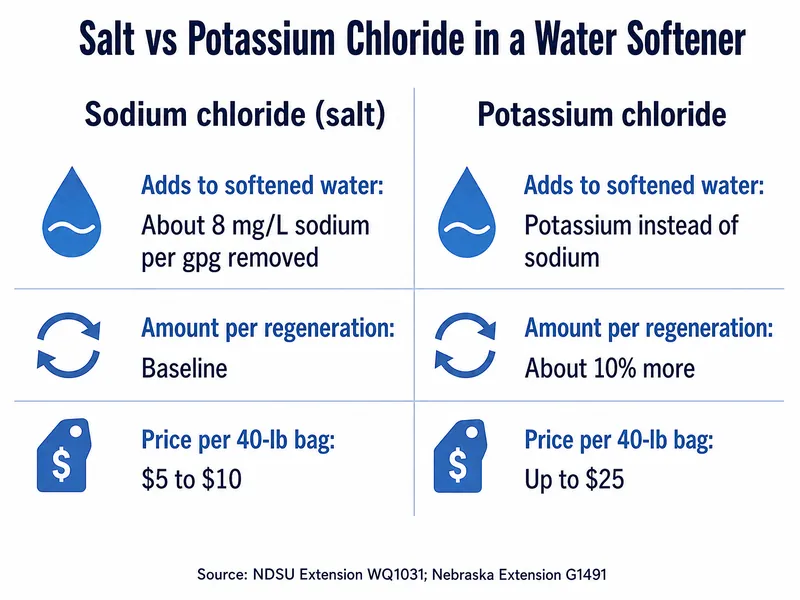
Potassium chloride in a water softener works like salt but adds potassium instead of sodium; NDSU Extension says it takes about 10% more, at up to $25 a 40-lb bag against $5 to $10 for salt.
By the Water Softener Reviews editors · Updated
On this page
- How is potassium chloride different from water softener salt?
- How much more potassium chloride does a softener need?
- What does potassium chloride cost compared with salt?
- Who should use potassium chloride in a water softener?
- How to switch your softener to potassium chloride
- Which salt or pellets should you buy?
- Mistakes that waste salt or potassium
- Which regenerant is right for most homes?
- Common questions
Key takeaways
- Salt adds about 8 mg/L of sodium for every grain per gallon removed, per NDSU Extension and Nebraska Extension.
- NDSU says a softener uses about 10% more potassium chloride than sodium chloride for the same regeneration.
- NDSU prices salt at $5 to $10 per 40-lb bag and potassium chloride at up to $25.
- A. O. Smith's softener manual says not to use potassium chloride when the water has iron or manganese.
- EPA's sodium advisory sets 20 mg/L as guidance only for people held to 500 mg of sodium a day.
- MedlinePlus lists salt substitutes and some blood pressure medicines among causes of high blood potassium, so ask your doctor before switching for health reasons.
Salt vs potassium in numbers
- 8 mg/LSodium added per gpg of hardness removed with saltNDSU Extension
- 10%Extra potassium chloride used per regenerationNDSU Extension
- $25Upper price of a 40-lb bag of potassium chloride ($5 to $10 for salt)NDSU Extension
- 20 mg/LEPA sodium guidance level for 500 mg/day dietsU.S. EPA
How is potassium chloride different from water softener salt?
Both recharge the same resin; the difference is which ion ends up in your water. During service the beads trade calcium and magnesium for sodium (from salt) or potassium (from potassium chloride), and during regeneration a brine rinse loads them up again. Hardness removal is the same; see how a water softener works for the full cycle.
With salt, Nebraska Extension's NebGuide G1491 puts the added sodium at about 8 mg/L for each gpg of hardness. Water at 10 gpg ends up near 80 mg/L, and 2 liters a day of it carries about 160 mg, roughly 7% of the FDA's 2,300 mg daily limit. Potassium chloride avoids that sodium; Morton sells its potassium chloride pellets as 99% sodium free.
| Factor | Sodium chloride (salt) | Potassium chloride |
|---|---|---|
| Ion added to water | Sodium, about 8 mg/L per gpg removed | Potassium |
| Dose for the same regeneration | Baseline | About 10% more (NDSU) |
| Price per 40-lb bag | $5 to $10 (NDSU) | Up to $25 (NDSU) |
| Iron or manganese in water | Usable | Not recommended (A. O. Smith) |
| Availability | Common | Can be harder to find (Nebraska Extension) |
How much more potassium chloride does a softener need?
Plan on about 10% more. NDSU Extension says potassium chloride "adheres more strongly to the resin," which lowers exchange efficiency, and that about 10% more of it is used in the backflush.
Makers set their own factor, so read your manual. A. O. Smith tells owners of its AOW-S400 and AOW-S500 softeners to multiply compensated hardness by 1.12 when they use potassium chloride, a 12% bump. The Water Quality Association states a 13 to 15% higher brine concentration. Some valves have a potassium setting; on others you raise the hardness or salt setting yourself.
What does potassium chloride cost compared with salt?
Expect a bigger yearly bill, because both the price and the dose go up. NDSU gives $5 to $10 for a 40-lb bag of sodium chloride and up to $25 for the same bag of potassium chloride, and you need about 10% more of it.
| Item | Sodium chloride | Potassium chloride |
|---|---|---|
| Bags per year | 6 x 40 lb (240 lb) | About 6.6 x 40 lb (264 lb) |
| Price per bag (NDSU) | $5 to $10 | Up to $25 |
| Cost per year | $30 to $60 | Up to about $165 |
Six bags is the high end of SoftPro's figure for its Elite softener, which it states uses one 40-lb bag every 2 to 4 months. Morton's FAQ puts an average household at about two bags every two months, or 12 a year, which doubles both columns. Efficient valves narrow the dollar gap: SoftPro states the Elite's precision brining saves up to 30% salt, and the ECO uses 10% less salt than traditional systems. Our water softener cost guide covers the rest of the running costs.
Who should use potassium chloride in a water softener?
Potassium chloride makes sense when sodium matters at every tap. NDSU calls the swap appropriate when "health or environmental reasons" mean restricting sodium. For drinking water alone, NDSU and Nebraska Extension both suggest a cheaper route: a cold line to the kitchen tap that bypasses the softener. Our guide to whether soft water is safe to drink works through the sodium math.
Potassium is not risk-free for everyone. MedlinePlus notes that kidneys that are not working well may not clear potassium, and lists ACE inhibitors and salt substitutes among causes of high blood potassium. If you have kidney disease or take blood pressure medicine, ask your doctor before choosing either regenerant for health reasons.
Skip potassium chloride if your water carries iron or manganese. A. O. Smith's manual says not to use it in that case, and Pentair's 5600SXT system manual lists sodium chloride pellets as the acceptable salt type, so check your own manual first.
How to switch your softener to potassium chloride
- Check the manual. Confirm the maker allows potassium chloride and note its adjustment.
- Let the brine tank run low. A. O. Smith says not to mix salt types, so avoid topping up salt with potassium.
- Change the setting. Select the potassium mode or raise the dose by about 10%, or by the maker's factor.
- Fill with potassium chloride. Keep the level within the maker's range.
- Test a week later. Check a cold softened tap with a hardness strip; if hardness creeps through, raise the setting a little.
Which salt or pellets should you buy?
Buy clean pellets or solar salt made for softeners, not rock salt. A. O. Smith recommends "clean white pellet, cube-style, or solar salt," says not to use rock salt, and warns against mixing pellets with solar salt. Pentair's 5600SXT system manual says rock and snow-melting salt carry dirt and chemicals that affect the softener, and Nebraska Extension notes rock salt "may have high levels of soluble or insoluble impurities."
Fill level matters as much as the bag. Pentair says its salt tank works best below half-full, because fuller tanks let pellets wedge into a "bridge" that never reaches the water. A. O. Smith asks owners to keep it at least one-third full. Push a broom handle into the salt to find and break a bridge; Pentair says to wait 2 hours and then run a regeneration.
Mistakes that waste salt or potassium
Keeping the old setting
Potassium at the salt dose leaves the resin short, and hard water leaks through.
Using rock salt to save money
Two maker manuals rule it out because of dirt and insoluble grit.
Overfilling the brine tank
Pentair links a tank more than half full to salt bridges.
Paying for whole-house potassium
If only the kitchen tap matters, a bypass line costs less every year.
Related guides



Which regenerant is right for most homes?
Most homes do well with clean salt pellets and a bypass or RO tap if anyone limits sodium. Choose potassium chloride when sodium matters at every tap, your water has no iron or manganese, and your manual allows it, then pair it with an efficient metered softener so each pricier bag goes further. Our best water softeners roundup ranks units by efficiency and size, and larger families should see best whole-house water softeners.
How we put this page together
Sources: NDSU Extension WQ1031, Nebraska Extension NebGuide G1491, the WQA softener booklet, EPA's 2003 sodium advisory, FDA and MedlinePlus pages, A. O. Smith and Pentair softener manuals, and Morton's product pages, checked October 2026. SoftPro figures come from SoftPro's own product pages. We left out unsourced claims from the old page, including a "10 to 25% more" dose and "several times the price", and we did no lab testing.
Common questions
Does potassium chloride soften water as well as salt?
Yes, when the dose is raised. NDSU says it holds more tightly to the resin, so about 10% more is needed to remove the same hardness.
Does every water softener accept potassium chloride?
Not always. A. O. Smith rules it out when water has iron or manganese, and Pentair's 5600SXT system manual names sodium chloride pellets as the acceptable salt. Check your manual.
Is it fine to mix salt and potassium chloride in the brine tank?
No. A. O. Smith's manual says not to mix salt types. Let the tank run low before you change over.
Is potassium chloride better for plants and lawns?
It avoids sodium, but the simpler answer is to leave outdoor taps unsoftened. NDSU does not recommend softened water for house plants, lawns or gardens.
How much does potassium chloride cost per year?
For a home using six bags of salt, about 6.6 bags of potassium chloride at up to $25 each, or up to about $165, against $30 to $60 for salt at NDSU's prices.
Is potassium chloride safe for people with kidney disease?
Ask your doctor. MedlinePlus notes that weak kidneys may not clear potassium and that salt substitutes can raise blood potassium.
What causes a salt bridge?
A. O. Smith blames high humidity or the wrong kind of salt; Pentair links it to a tank filled past half. Break it with a broom handle.
Comparing options? Start with our guide to choosing a water softener.