
Guides
How to Install a Water Softener
How do you install a water softener? Plumb it into the main line before the water heater, fit the bypass, run a 1/2-inch drain line to an air gap, then add water and salt and start it.
By the Water Softener Reviews editors · Updated
On this page
- Where should a water softener be installed?
- What do you need before you install a water softener?
- How to install a water softener, step by step
- How should the drain and overflow lines be run?
- How do you start up a new softener?
- Install errors that cause callbacks
- Choosing a DIY-friendly system
- Common questions
Key takeaways
- EPA WaterSense says to install the softener before the water heater and, where possible, after the branch to outdoor taps.
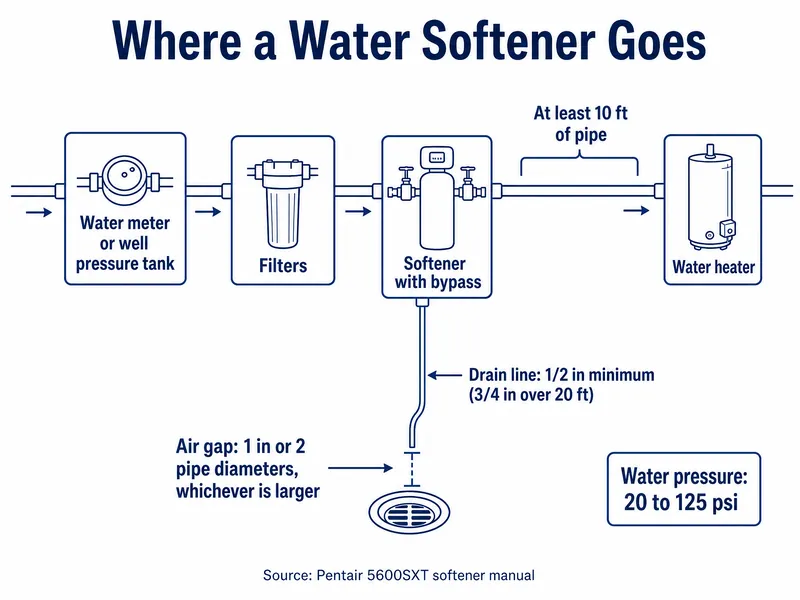
- Pentair's 5600SXT manual requires 20 to 125 psi of water pressure and at least 10 feet of pipe between the softener and the water heater.
- The drain line must be at least 1/2 inch, or 3/4 inch on runs over 20 feet, and end in an air gap of 2 pipe diameters or 1 inch, whichever is larger.
- The brine tank overflow needs its own line to the drain; Pentair says never tie it into the valve's drain line.
- SoftPro and Quality Water Treatment install guides allow about 3 hours for a handyman and 4 hours DIY.
- A regeneration sends about 50 gallons to the drain, which Penn State Extension says may or may not overload a septic system.
Where should a water softener be installed?
Install the softener on the main supply line after the water meter or well pressure tank and before the water heater. EPA WaterSense adds that, where possible, it should sit after the branch to outdoor hose bibs or irrigation, so you are not softening lawn water. Penn State notes toilets, outside spigots and basement sinks can also be bypassed.
On a well, SoftPro's Elite install guide says the softener will not work properly ahead of the pressure tank. Sediment filters, iron filters and neutralizers go upstream of the softener, per the Pentair 5600SXT manual; SoftPro's guide puts a UV unit after it. Check our sizing guide before you order.
Pick a level floor within reach of a drain and an outlet. Pentair asks for ambient temperatures between 34°F and 120°F, and QWT's guide says freezing voids the warranty and that water above 120°F damages softeners.
Install numbers from the manuals
- 20–125 psiworking water pressure rangePentair 5600SXT manual
- 10 ftminimum pipe run from softener to water heaterPentair 5600SXT manual
- 1/2 inminimum drain line diameter (3/4 in over 20 ft)Pentair 5600SXT manual
- 1 inminimum air gap, or 2 pipe diameters if largerPentair 5600SXT manual
- 50 galwater used per regenerationPenn State Extension
What do you need before you install a water softener?
You need the maker's manual, fittings for your pipe type, drain tubing and a grounded outlet. Pentair says the outlet must be grounded and always on, so avoid a switched outlet, and SoftPro's code checklist (SoftPro, a store run by our team) asks for one within 10 feet with no extension cord.
| Item | Limit | Source |
|---|---|---|
| Water pressure | 20–125 psi (Canada under 100 psi) | Pentair 5600SXT manual |
| Ambient temperature | Over 34°F and below 120°F | Pentair 5600SXT manual |
| Pipe run to water heater | At least 10 ft | Pentair 5600SXT manual |
| Distance to drain | Above it and no more than 20 ft away | Pentair 5600SXT manual |
| Drain lift | Up to 6 ft if the run is 15 ft or less and pressure is at least 40 psi | Pentair 5600SXT manual |
| Drain lift, SoftPro Elite | Up to 3 ft above the drain port | SoftPro Elite install guide |
QWT's parts list for a Fleck 5600SXT covers thread seal tape, 1/2-inch ID drain tubing with a hose clamp, drain fittings and push-fit connectors for copper, PEX or CPVC. Pentair adds three rules: use plumber's tape on threads, use only silicone grease on O-rings, and never use pipe smaller than your main line. Where galvanized pipe meets new copper, use dielectric connectors.
Check permits first. SoftPro's guide puts permits at $50 to $300, and our cost guide covers what a plumber charges if you would rather not do it yourself.
How to install a water softener, step by step
Read your manual end to end before cutting anything; drain ports, brine fittings and menus differ by brand.
- Turn off the water heater. Set gas units to pilot or switch off power to electric units.
- Shut off the main and drain the lines. Open a low and a high faucet to relieve pressure.
- Stand the tanks in place. Pentair warns never to turn the resin tank upside down or lay it on its side, because loose media can get into the valve.
- Cut into the main and fit the bypass. Run pipe or flexible connectors from the main to the bypass on the valve. Do not support the system's weight on the plumbing.
- Match inlet and outlet. On a cut softener loop, SoftPro's guide says to crack the main slightly: the pipe that flows is the supply, which goes to IN.
- Restore the electrical ground. Where plastic interrupts metal pipe, QWT's guide calls for an approved ground clamp with no less than #6 copper wire across the gap.
- Run the drain line. Clamp 1/2-inch tubing to the valve's drain fitting and route it to a floor drain, standpipe or laundry tub, ending in an air gap.
- Run the overflow line. Connect separate tubing from the brine tank overflow fitting to the drain, running downhill.
- Connect the brine line between the brine tank and the valve.
- Open the water slowly. Pentair says to fill the media tank slowly so resin does not leave the tank, then purge air at a cold tap.
- Program the valve. Enter time of day and hardness in grains per gallon; SoftPro's guide says to divide a mg/L result by 17.1.
- Add water and salt, plug in, and check for leaks. Switch the water heater back on once soft water is flowing.
How should the drain and overflow lines be run?
Run the drain line to an open receptor with an air gap, never straight into a pipe. Pentair's manual says the gap must be 2 pipe diameters or 1 inch, whichever is larger, and warns that inserting the line into a drain, sewer or trap risks sewage being back-siphoned into the softener. State code can be stricter; Massachusetts 248 CMR 10.12 requires an indirect-waste air gap of at least twice the drain's diameter.
Where the drain is lower than the valve, Pentair calls for a 7-inch loop at the far end of the line to act as a siphon break. The overflow line works by gravity, so it must never rise above its fitting, and it must be a separate line with its own air gap.
Septic owners have a few extra checks. University of Maryland Extension advises against connecting softener backwash to the septic tank, while Purdue Extension describes an Indiana rule letting recharge water go to a soil absorption field. WQA's septic toolkit recommends high-efficiency, demand-initiated units. Follow your local code.
How do you start up a new softener?
Start-up depends on whether the resin arrives pre-charged. The Fleck manual walks the valve through backwash, brine draw and rinse by hand, while QWT and SoftPro say their pre-loaded systems need no manual regeneration.
| System | Water in brine tank | Salt to add | First regeneration |
|---|---|---|---|
| Fleck 5600SXT (Fleck service manual) | About 1 in above the grid plate | After the manual cycle | Cycle the valve by hand |
| Fleck 5600SXT from QWT | 2 gallons | Two 40-lb bags | Not required (pre-charged resin) |
| SoftPro Elite | 3 gallons | 1–3 bags | Not required |
SoftPro's guide says to open the bypass inlet only about a quarter turn until the tank fills, then open the outlet slowly and run a cold soft-water tap until it clears. Test hardness at a cold tap afterward; our guide to how a water softener works explains the cycle you just started.
Install errors that cause callbacks
Hard-piping the drain
No air gap means a back-siphon risk and a likely code failure.
Teeing the overflow into the drain line
Pentair requires a separate overflow line; a shared line can back water into the brine tank.
Skipping the ground clamp
Cutting metal pipe can break the home's electrical ground path.
Opening the water too fast
A rush of water can push resin out of the tank and trap air.
Choosing a DIY-friendly system
Choose a system that ships with a bypass and quick-connect fittings. The SoftPro ECO City includes a pre-installed bypass, and QWT includes a 3/4-inch plastic bypass with its Fleck 5600SXT, which it states installs in about 2 hours. Our best whole-house water softeners roundup lists what each pick includes, and our well water picks cover iron filters that mount ahead of the softener.
Related guides
Common questions
Can a homeowner install a water softener?
Usually, if you can cut and join your pipe type and your town allows owner plumbing work. Some areas require a permit or inspection, and EPA WaterSense notes some jurisdictions restrict softeners, so check first.
Does a water softener go before or after the water heater?
Before it. EPA WaterSense says to install it before water enters the heater, and Pentair asks for at least 10 feet of pipe between them so hot water cannot back up into the valve.
Where should the softener drain line go?
To a floor drain, standpipe or laundry tub, ending in an air gap of at least 1 inch or 2 pipe diameters. Keep it within 20 feet of the drain unless you upsize to 3/4-inch tubing.
Does a water softener need its own outlet?
It needs a grounded outlet that stays on. Pentair says not to use a switched outlet, and the 5600SXT control runs on 12 volts through the supplied adapter.
Should outdoor taps get softened water?
Usually not. Penn State and WQA both suggest bypassing outside spigots, which saves salt and water.
What pressure does a water softener need?
Pentair rates its 5600SXT systems for 20 to 125 psi. QWT's Fleck install guide asks for at least 30 psi at the tank inlet on well systems.
How long does it take to install a water softener?
QWT's and SoftPro's install guides allow about 3 hours for a handyman or plumber and 4 hours for a homeowner. A pre-plumbed softener loop can cut that.
How we put this page together
This page is based on Pentair's 5600SXT softener system manual (4005293 Rev B), the Fleck 5600SXT service manual, the Quality Water Treatment Fleck 5600SXT install guide, SoftPro's Elite install guide and code checklist, EPA WaterSense's softener guide, Penn State, University of Maryland and Purdue Extension publications, WQA's septic toolkit and Massachusetts plumbing code, all checked in October 2026. Where manuals disagree, we name the source. We left out state code rules we could not open, forum advice and any testing of our own.
Comparing options? Start with our best water softeners and reviews.