
Guides
Hard Water Effects on Skin and Hair
Hard water's effects on skin and hair come mainly from soap curd left behind; lab work links hardness to more detergent residue on skin, but a 336-child trial found softeners added no eczema benefit.
By the Water Softener Reviews editors · Updated
On this page
Key takeaways
- Nebraska Extension's G1274 says bathing with soap in hard water leaves "a film of sticky soap curd on the skin" and can leave hair dull.
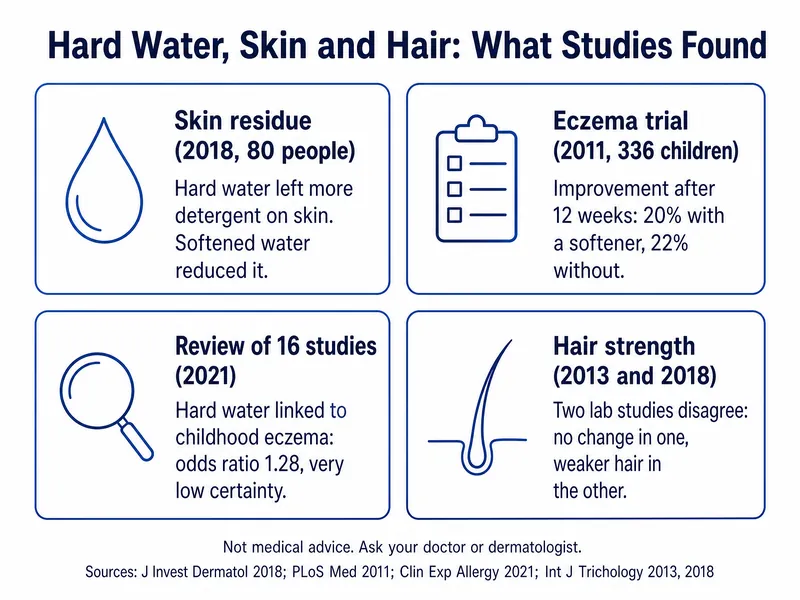
- In a 2018 study of 80 people, skin washed in hard water held significantly more detergent residue; ion-exchange softening reduced the effect.
- The SWET trial of 336 children found 20% eczema improvement with a softener and 22% without: no added benefit.
- A 2021 review of 16 studies found hard water linked with childhood eczema (odds ratio 1.28, very low certainty), but no evidence softeners improve existing eczema.
- Two small lab studies of cut hair disagree: one (15 volunteers) found no strength change, the other (70 men) found hair about 8% weaker after hard-water soaks.
- Softening is a comfort choice, not a treatment. Ask your doctor or dermatologist about any skin or hair condition.
What the studies measured
- 80People whose skin was washed in hard vs softened water (Danby 2018)J Invest Dermatol, via PubMed
- 336Children with eczema in the SWET softener trialPLoS Medicine, via PMC
- 20% vs 22%Eczema improvement at 12 weeks, softener vs usual carePLoS Medicine, via PMC
- 1.28Odds ratio for childhood eczema in harder water areas (very low certainty)Clin Exp Allergy, via PubMed
How does hard water affect skin and hair?
Mostly through soap. Calcium and magnesium react with soap to form curd, and some of it stays behind. G1274 says that film sticks to skin, that soap curd "on hair may make it dull, lifeless, and difficult to manage," and that hard water grays white laundry. Penn State Extension also lists "soap films on skin" among the signs of hard water.
The minerals themselves are not a health hazard; G1274 says so directly. The issue is residue and how it feels: the USGS notes that hard water takes more soap to clean and can leave hands feeling slimy after washing. Towels and sheets washed in hard water pick up the same residue.
How hard is hard enough to matter? Penn State says water below 7 gpg will probably not cause major scaling or soap film. Above that, and especially over 10.5 gpg (very hard), soap film is easier to see on tile, glass and in the tub. Our guide on whether you need a water softener explains how to get your number.
What does research say about hard water and skin?
The research supports a mechanism but not a cure. The strongest lab evidence and the strongest trial point in different directions, so cautious wording is the honest answer.
| Study | Who or what | Main finding |
|---|---|---|
| Danby et al., 2018 | 80 people, skin washed with a detergent in hard vs softened water | Hard water left more detergent residue and irritation; softening reduced it |
| SWET trial (Thomas et al., 2011) | 336 children with moderate or severe eczema, 12 weeks | 20% vs 22% improvement; softeners added no benefit |
| Jabbar-Lopez et al., 2021 review | 16 studies, 385,901 people in pooled observational data | Hard water linked with childhood eczema (very low certainty); no evidence softeners help existing eczema |
| Srinivasan et al., 2013 | Hair from 15 volunteers, 30 days of soaks | No significant change in hair strength or elasticity |
| Luqman et al., 2018 | Hair from 70 men | Hard water soaks lowered tensile strength (234 vs 255) |
The lab result. Danby and colleagues washed the skin of 80 people, including people with atopic dermatitis, using sodium lauryl sulfate in water of different hardness. Hard water left significantly more of the detergent on the skin, which raised water loss and irritation, most of all in people with a filaggrin gene mutation. Ion-exchange softening reduced those effects. The authors say an intervention study is needed to test whether this matters in real life.
The trial result. The Softened Water Eczema Trial put softeners in the homes of 336 children in hard water areas of England. Nurses who did not know which homes had softeners scored eczema at 12 weeks: 20% improvement with a softener, 22% with usual care alone. Parents reported some gains, which the authors put down to likely response bias, since families knew which group they were in.
The review. A 2021 systematic review pooled observational data and found an association between hard water and eczema in children, rated very low certainty, and found no evidence that domestic softeners improve objective severity in established eczema. It flags early life as the open question; a 78-family pilot trial (SOFTER, 2022) was too small to test it.
Does hard water damage hair?
The evidence is thin and split. In a 2013 study, hair from 15 volunteers soaked in hard or distilled water for 30 days showed no significant difference in tensile strength or elasticity. A 2018 study of hair from 70 men found hard-water soaks lowered tensile strength to 234, against about 255 for untreated and deionized samples, and concluded hard water increases breakage.
Both tested cut hair in a lab, not hair on a scalp, and neither studied hair loss. For thinning or shedding, see a doctor or dermatologist; hair loss has many causes that water treatment will not address.
How can you check whether hard water is the cause?
- Find your hardness. Use a test strip or your utility's water quality report; divide mg/L by 17.1 for gpg.
- Rule out the obvious. Very hot water, long showers and harsh soaps dry skin on any water. Change those first.
- Use less product. More soap or shampoo on hard water means more curd to rinse away.
- Try a clarifying or chelating shampoo to lift mineral buildup from hair.
- Ask a professional. For eczema, dermatitis, itching that will not settle, or hair loss, talk to your doctor or a dermatologist before buying equipment.
Softener or shower filter for skin and hair?
A whole-house water softener is the usual way to take calcium and magnesium out of shower water. It does that by trading the minerals for sodium or potassium on a resin it recharges with brine, as Nebraska's G1491 describes. Salt-free conditioners and physical devices do not remove hardness, per Nebraska Extension, so the rinse feels much the same.
A shower filter only removes hardness if it contains ion-exchange media and a way to recharge it, so read what the box actually claims; a filter that lists only chlorine reduction will not change hardness. For what it is worth, the Danby study found no clear effect of chlorine on its skin results.
If hard water is the cause and you want the change in the shower and the laundry, a softener is the option that addresses it, with the caveats above. Our best water softeners roundup ranks units by water type, city homes that also want carbon filtration should see best softeners for city water, and softener vs conditioner explains why a salt-free unit changes little here. NDSU notes softened water carries about 8 mg/L of sodium per gpg removed; is soft water safe to drink covers that.
Common missteps
Expecting a medical fix
The 336-child SWET trial found no added eczema benefit. Treat softening as comfort, not care.
Buying a filter for hardness
Check the media. Without ion exchange, calcium and magnesium pass through.
Choosing salt-free for the feel
Conditioners leave hardness in the water, so soap behaves about the same.
Overusing product
More shampoo on hard water means more residue. Use less and rinse longer.
Related guides
 GuidesDo you need a water softener?
 GuidesHow does a water softener work?
 GuidesIs soft water safe to drink?
 CompareSalt-based vs salt-free softeners
How we put this page together
Sources: Nebraska Extension NebGuides G1274, G1491 and G2275, Penn State Extension, NDSU Extension and the USGS, plus peer-reviewed studies read in their PubMed or PMC records: Danby 2018, the SWET trial 2011, the 2021 Jabbar-Lopez review, the 2022 SOFTER pilot and two hair-strength studies (2013, 2018), checked October 2026. Nothing here is medical advice. We left out forum anecdotes, user reviews, unsourced shower-filter media claims, and anything about treating skin conditions, and we did no lab testing.
Common questions
Can hard water cause hair loss?
No study we found shows that. Two lab studies of cut hair disagree on whether hard water weakens strands, and neither looked at hair on the scalp. See a doctor or dermatologist about hair loss.
Does a water softener help eczema?
The best trial says not for existing eczema: 336 children improved 20% with a softener and 22% without. Ask your doctor or dermatologist about eczema care.
Can hard water cause eczema in babies?
It is an open question. A 2021 review found an association with very low certainty, and a small 2022 pilot trial was not designed to answer it. Talk to your pediatrician.
Why does softened water feel slippery?
Without calcium and magnesium, soap does not form curd, so it rinses off differently. G1274 links the film people feel on hard water to that curd.
Does chlorine dry out skin more than hardness?
In the Danby study, a clear effect of chlorine on detergent irritation was not observed, while hard water had one. Chlorine and hardness need different treatment.
Will a salt-free conditioner help my skin and hair?
Unlikely to change the feel. Nebraska Extension says these devices do not remove hardness from the water.
What hardness level affects skin and hair?
There is no agreed cutoff for skin. Penn State says soap film is probably minor below 7 gpg, and the eczema trial homes had at least 200 mg/L, about 12 gpg.
Comparing options? Start with our guide to choosing a water softener.