
Compare
GE vs Whirlpool Water Softeners
GE vs Whirlpool water softeners: GE's GXSH45W gives 45,000 grains, a Wi-Fi app and a $799 price (October 2026), while Whirlpool's WHES40 gives 40,000 grains, a 10 ppm iron rating and no published price.
By the Water Softener Reviews editors · Updated
Disclosure: watersofteners.reviews is run by the same team as SoftPro Water Systems and Quality Water Treatment, and we rank their products first. We compare published specifications, certifications, warranties and prices (as of October 2026). We did not lab-test these units. How we rank
On this page
- GE vs Whirlpool: which water softener should you buy?
- How do GE and Whirlpool softeners compare on paper?
- Which has more capacity and iron handling, GE or Whirlpool?
- What does each softener cost to run?
- How do GE vs Whirlpool prices and warranties compare?
- Which should you choose?
- When should you look beyond GE and Whirlpool?
- Common questions
Key takeaways
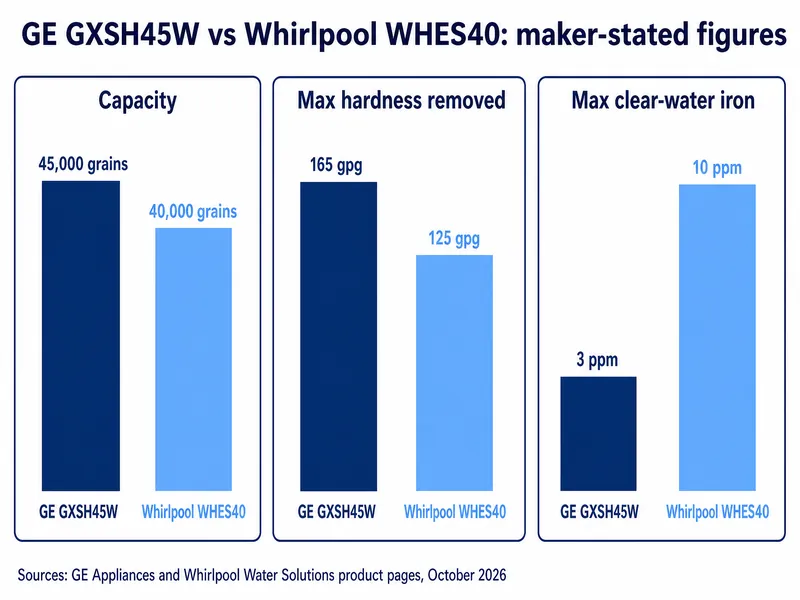
- The GXSH45W is rated by GE for 45,000 grains, up to 165 gpg and up to 3 ppm clear-water iron (GE product page).
- Whirlpool rates the WHES40 at 40,000 grains, 125 gpg of hardness and 10 ppm of clear-water iron, with a valve that fits plumbing up to 1-1/4 inches.
- GE publishes 5,090 grains removed per lb of salt, above the 3,350 benchmark in the EPA WaterSense guide; Whirlpool publishes no efficiency figure.
- GE lists the GXSH45W at $799 as of October 2026; Whirlpool shows no price on its maker pages.
- Whirlpool's 1-year warranty extends to 5 years with registration and cleanser use; GE covers the whole unit 1 year, electronics 3 and the resin tank 10.
- Both top out at 45,000 grains or less, below the 48,000 to 64,000 grains a larger family at 10 gpg usually needs.
GE vs Whirlpool: which water softener should you buy?
Pick GE if you want a known price, phone alerts and a published salt-efficiency figure; the GXSH45W is the more complete package for city water. Pick Whirlpool's WHES40 if your well has dissolved iron between 3 and 10 ppm, because its stated iron rating is more than three times GE's, and its valve takes pipe up to 1-1/4 inches.
Neither brand suits a large household well. Both stop at 45,000 grains or less, and both keep full-unit coverage short. The last section of this page points to systems built for bigger loads.
What the numbers say
- 45,000grains, GE GXSH45W capacityGE Appliances
- 10 ppmclear-water iron rating, Whirlpool WHES40Whirlpool Water Solutions
- 165 gpgmax hardness, GE GXSH45WGE Appliances
- 5,090grains removed per lb of salt, GE GXSH45WGE Appliances
- 10.5 gpgthreshold above which water is classed very hardNebraska Extension G1491
How do GE and Whirlpool softeners compare on paper?
GE publishes more numbers; Whirlpool wins on iron and pipe size. Every figure below is from the makers' own product and warranty pages, read in October 2026.
| Item | GE GXSH45W | Whirlpool WHES40 | Whirlpool WHES30 |
|---|---|---|---|
| Capacity | 45,000 grains | 40,000 grains | 30,000 grains |
| Regeneration | Electronic-Demand Driven | Demand Regeneration | Demand Regeneration, 6th Sense |
| Max hardness | 165 gpg | 125 gpg | Not published |
| Max clear-water iron | 3 ppm | 10 ppm | Not published |
| Service flow | 9.5 gpm at 15 psi drop | Not published | Not published |
| Plumbing | 1" NPT valve | Up to 1-1/4" | Up to 1" |
| Salt efficiency | 5,090 grains per lb | Not published | Not published |
| Salt storage | 230 lb | Not published | Not published |
| App / Wi-Fi | SmartHQ app | None listed | None listed |
| Certifications | Not published | Not published | Not published |
| Warranty | 1 yr whole appliance; electronics 3 yr; resin tank 10 yr | 1 yr, 5 yr with registration and cleanser | Same as WHES40 |
| Price (Oct 2026) | $799 | Not published | Not published |
GE also sells the 35,000-grain GXSH35W ($699), the older 40,000-grain GXSH40V ($569) and GXSHC40N ($656), and the Profile PNPR45W ($1,599), all as of October 2026. Water Channel Partners builds Whirlpool's softeners under license.
Which has more capacity and iron handling, GE or Whirlpool?
GE has the bigger tank; Whirlpool has the higher iron rating. The 45,000-grain GXSH45W edges the 40,000-grain WHES40, and at 10 gpg both suit three or four people. Use our sizing guide to run your own numbers.
On hardness, GE rates the GXSH45W to 165 gpg and Whirlpool rates the WHES40 to 125 gpg. Both sit far above the 10.5 gpg line where Nebraska Extension classes water as very hard, so this rarely decides it.
Iron is Whirlpool's clearest win: 10 ppm of clear-water iron against 3 ppm for the GXSH45W. GE's older GXSH40V and GXSHC40N are rated to 8 ppm. Keep the general limits in mind: NDSU Extension says some softeners remove up to 10 ppm of iron and manganese, while Nebraska Extension warns that iron above 5 ppm or hydrogen sulfide can reduce softener performance. Red or orange iron, iron bacteria and sulfur odor need a dedicated filter with either brand.
On flow, GE publishes 9.5 gpm at a 15 psi drop. Whirlpool publishes no flow figure, but the WHES40 valve fits plumbing up to 1-1/4 inches, which matters in homes with larger supply lines.
What does each softener cost to run?
GE is the only one of the two with a salt-efficiency rating, so only its salt use can be estimated. At 5,090 grains per pound, four people using 75 gallons each a day at 10 gpg (the planning figures in Penn State Extension's guide) need roughly 215 lb a year, or five to six 40 lb bags. NDSU puts sodium chloride at about $5 to $10 a bag. Whirlpool publishes no comparable figure.
Whirlpool recommends evaporated salt pellets or solar salt crystals with under 1% impurities and advises against block salt. The GE's brine tank holds 230 lb of salt, so refills are infrequent in a typical home.
Two running costs are easy to miss. Whirlpool's five-year warranty depends on buying and using its softener cleanser, a recurring purchase; GE's warranty has no such condition. GE's SmartHQ app reports flow, flags leaks, reminds you about salt and has a vacation mode; a remote shutoff valve (RMVALVESFT) is sold separately. Whirlpool's pages list no app or Wi-Fi features for these two models.
How do GE vs Whirlpool prices and warranties compare?
GE lists the GXSH45W at $799 as of October 2026. Whirlpool shows no price for the WHES30 or WHES40 on its product pages, so a direct price comparison isn't possible from maker data. For budgeting the rest of the job, our cost guide covers installation and salt.
GE covers the whole appliance for one year, the electronic monitor for three and the resin tank for ten. Whirlpool starts at one year and extends to a five-year full warranty after registration and regular cleanser use. Its PRO models (WHEC46, WHESFC, WHES48) can go from two years to ten on the same terms.
Which should you choose?
Match the brand to your home
City water, 2 to 4 people
GE GXSH45W: known price, app alerts and published salt efficiency.
Well water with 3 to 10 ppm clear iron
Whirlpool WHES40, rated for 10 ppm of clear-water iron.
Larger supply pipe
Whirlpool WHES40, which connects to plumbing up to 1-1/4 inches.
Five or more people
Neither; see the next section.
When should you look beyond GE and Whirlpool?
Look further if you have five or more people, iron above 10 ppm or any red-water iron, or want a control valve covered for many years. Our best whole-house softeners include sizes to 64,000 grains: SoftPro covers the Elite's valve and essential components for life under a limited warranty, and the Fleck 5600SXT has five years on its valve. For wells, start with our best softeners for well water; for heavy iron or rotten-egg odor, our iron and sulfur picks pair softeners with dedicated filters.
The overall rankings place the WHES40 at #7 and the GXSH45W at #8. Single-brand detail is in our GE review and Whirlpool review.
Related guides
Common questions
Is GE or Whirlpool better for well water?
For dissolved iron, the Whirlpool WHES40's 10 ppm rating beats the GE GXSH45W's 3 ppm. For iron above that, red water or sulfur odor, neither softener alone is enough; add an iron filter.
Which costs less, GE or Whirlpool?
GE lists the GXSH45W at $799 as of October 2026. Whirlpool publishes no price for the WHES30 or WHES40 on its own pages, so the comparison can't be made from maker data.
Does Whirlpool have a smart water softener like GE?
Whirlpool's WHES30 and WHES40 pages list no app or Wi-Fi features. GE's GXSH45W connects to the SmartHQ app for leak, flow and low-salt alerts.
Which has the better warranty?
Whirlpool can reach five years with registration and regular cleanser use. GE gives one year on the whole unit, three on electronics and ten on the resin tank, with no cleanser condition.
Can block salt go in a Whirlpool softener?
Whirlpool advises against any block salt and recommends evaporated pellets or solar crystals with less than 1% impurities. Pellets or crystals work in the GE as well.
Who makes Whirlpool water softeners?
Water Channel Partners, based in Eagan, Minnesota, builds them under a Whirlpool license, according to Whirlpool's softener site.
Is the GE GXSH45W certified to NSF/ANSI 44?
GE's Claims & Certifications tab showed no standard for the GXSH45W when we checked, and Whirlpool publishes none for the WHES40. The EPA suggests NSF/ANSI 44 as the certification to look for.
How we put this page together
This page is based on GE Appliances' product pages for the GXSH45W, GXSH35W, GXSH40V and GXSHC40N, Whirlpool Water Solutions' WHES30, WHES40 and extended-warranty pages, EPA WaterSense's 2026 buyer guide, and Nebraska, NDSU and Penn State Extension publications, all checked in October 2026. We worked out the yearly salt figure ourselves from GE's efficiency rating. Whirlpool's pages are cited by name but not linked. We left out retailer prices, review scores, owner forum posts and any testing of our own.
Comparing options? Start with our best water softeners and reviews.