
Guides
How Long Do Water Softeners Last?
How long do water softeners last? About 10 years is the service life reported in a 2023 peer-reviewed study, and resin maker Purolite says premium resin can run over ten years when chlorine and iron are controlled.
By the Water Softener Reviews editors · Updated
On this page
Key takeaways
- A 2023 study in Environmental Science & Technology states that residential softeners have reported 10-year service lives (Jankowski et al., via NIH PMC).
- Resin maker Purolite says premium softening resin can give reliable operation for over ten years in a well-designed system.
- Purolite's rule of thumb: each 1 ppm of chlorine in the feed water cuts resin life by 50%, while 0.3 ppm does little harm in cold water.
- The EPA allows public water systems up to 4.0 mg/L of chlorine or chloramine.
- Fleck 5600SXT systems from Quality Water Treatment carry a 5-year valve and 10-year tank warranty; GE, Rheem and Morton list 10 years on tanks.
- EPA WaterSense says resin beads need cleaning annually to keep their efficiency.
How long do water softeners last?
A salt-based water softener lasts about 10 years on the best published evidence, and longer when its resin and valve are looked after. The 10-year figure comes from a peer-reviewed 2023 study of residential softeners, which itself cites a maker's product listing, so treat it as a typical figure rather than a limit.
The tanks rarely set the limit. Resin and valve seals wear first, and both can be replaced, so a softener's life is mostly a question of when repairs stop being worth it.
What the sources say
- 10 yearsreported service life of residential softenersJankowski et al., Environ. Sci. Technol. 2023
- 10+ yearsreliable operation for premium resin in a well-designed systemPurolite
- 50%cut in resin life for each 1 ppm of chlorine in the feed waterPurolite
- 4.0 mg/Lmaximum chlorine or chloramine residual allowed in public waterU.S. EPA
- 10 yearstank warranty on GE, Rheem, Morton and QWT's Fleck 5600SXTmaker and store pages (a store run by our team)
What wears out first on a water softener?
The control valve's seals and the resin bed wear out first; the tanks usually outlast both. The Fleck 5600SXT service manual and the Pentair 5600SXT manual list worn seals, spacers and pistons, a plugged injector screen and a cracked distributor tube among the causes of hard water from a working softener.
| Part | What the sources say | What shortens it |
|---|---|---|
| Resin bed | Premium resin can run 10+ years (Purolite) | Chlorine, chloramine, iron fouling, warm water |
| Valve seals, spacers, piston | Serviceable parts in the Fleck manual | Sand, iron, debris after plumbing work |
| Injector and screen | Cleaned or replaced when plugged | Salt sludge, sediment |
| Mineral and brine tanks | 10-year tank warranties are common | Freezing, physical damage |
| Salt-free conditioner media | Replaced on the maker's schedule | Chlorine, iron, sediment |
Iron is resin's second enemy. Purolite says softening resin holds onto iron strongly, so iron builds up slowly and cuts capacity, and it also speeds up chlorine damage. Penn State Extension adds that red, oxidized iron clogs resin and that some fouled resin cannot be washed clean and must be replaced.
Salt-free conditioners have no resin, but their media wears out too. SoftPro states FORTRESS media lasts 2 years in the Home unit and up to 5 years in the Pro and Commercial units, and SoftPro's page gives the Elite Salt-Free media a life of 3 to 6+ years.
How does chlorine shorten water softener life?
Chlorine attacks the cross-links inside each resin bead, so the beads swell, soften and lose capacity. Purolite's guideline is that every 1 ppm of chlorine halves resin life, with each further ppm halving it again; at 0.3 ppm the effect is small in cold water, and warmer water speeds the damage.
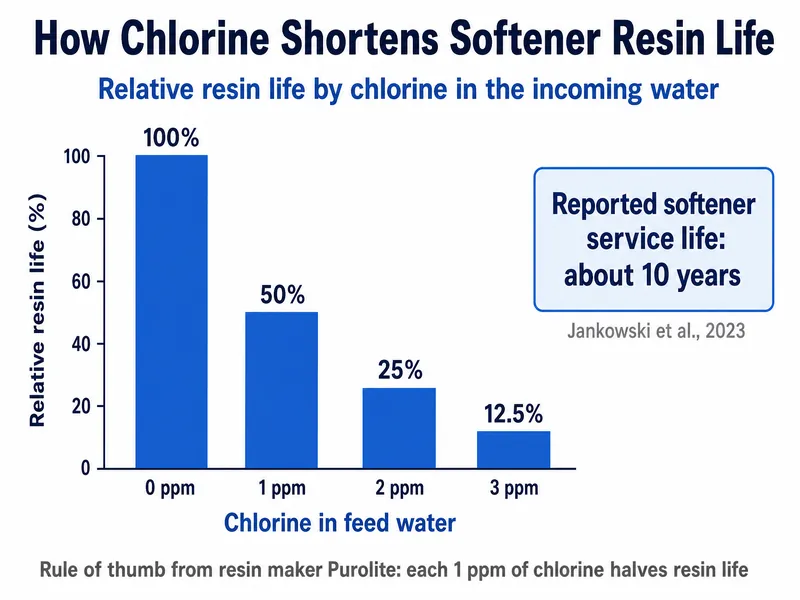
That matters on city water, where EPA allows up to 4.0 mg/L of chlorine. Purolite says higher cross-linking (more DVB) gives more resistance to oxidation, which is why 10% cross-link resin is sold for chlorinated supplies. A carbon filter ahead of the softener removes chlorine before it reaches the beads; our best softeners for city water pair the two.
Store figures for resin life disagree. SoftPro states the ECO City's 8% resin is engineered to last up to 20 years in normal use, while SoftPro's own resin-replacement article (SoftPro, a store run by our team) says most resin lasts around 5 to 10 years. We give the range rather than pick one.
What do warranties say about softener lifespan?
Warranties show what makers will stand behind, and most cover tanks for 10 years or more and valves for less. Read which parts each term covers before comparing.
| System | Valve | Tanks |
|---|---|---|
| SoftPro Elite | Limited lifetime on valve and essential components | Included in the same term |
| SoftPro ECO City | 10 years | Lifetime limited (mineral and brine tanks) |
| Fleck 5600SXT (QWT) | 5 years | 10 years |
| GE GXSH45W | 1 year entire appliance; 3 years electronic monitor | 10-year resin tank |
| Rheem RHS32 | 1 year parts and labor; 3 years electronics | 10 years |
| Morton | 1-year parts, extendable to 5 with Morton cleanser | 10 years mineral and salt tanks |
Repair or replace: the checks
Work through these checks before deciding; most of them come from the Fleck manual's troubleshooting table.
- Test the water. Soft water at a cold tap should read near zero; a reading close to your raw hardness means the softener is not working.
- Check the bypass. A bypass left partly open lets hard water through.
- Check the salt. If the level has not dropped in weeks, look for a salt bridge and break it with a broom handle, as EPA WaterSense describes.
- Check the settings. Confirm time of day and hardness, especially after a power outage.
- Watch a regeneration. Water should flow to the drain during backwash and rinse; no brine draw points to a plugged injector or screen.
- Flush the water heater. The Fleck manual lists hardness stored in the hot water tank as a cause of hard hot water after a repair.
- Look for beads. Resin in aerators usually means a cracked distributor tube.
- Note pressure. Lower pressure through the softener can mean iron buildup or fouled resin.
Repair, re-bed or replace? Repair when the tanks are sound and valve parts are still sold. Re-bed when hardness leaks through despite good brine draw and correct settings; our resin replacement guide covers it. Replace when a tank leaks, the valve is obsolete or the unit is now too small; check with our sizing guide.
How softeners get worn out early
No carbon filter on chlorinated water
At 1 ppm of chlorine, Purolite's rule halves resin life.
Treating iron with the softener alone
Iron builds up on resin and speeds chlorine damage. Fit an iron filter ahead of it; see our iron guide.
Rock salt or road salt
EPA WaterSense says to avoid rock, road and table salt; insolubles build sludge. See salt vs potassium.
Skipping the yearly resin cleaning
EPA WaterSense calls for cleaning resin beads annually with the maker's cleaner.
What to buy when you replace
Look for 10% cross-link resin on city water, a serviceable valve and warranty terms that name both the valve and the tanks. Our best water softeners for 2026 list puts SoftPro's Elite Smart HE first and the Fleck 5600SXT second, with warranty terms for every pick. For one system in depth, see the SoftPro Elite review.
Related guides
Common questions
What is the average lifespan of a water softener?
The best published figure is about 10 years, from a 2023 peer-reviewed study of residential softeners. Many units run longer with resin and valve service, and chlorine or iron can shorten that.
Can a water softener last 20 years?
Some makers claim components can; SoftPro states the ECO City's resin is engineered for up to 20 years in normal use. We found no primary source for a 20-year system life, so plan around 10 and expect repairs along the way.
What fails first on a water softener?
Usually the valve's seals and piston, or the injector plugging with sediment or salt sludge. Resin wear shows up later as slowly rising hardness.
Is it worth fixing an old water softener?
Often, if the tanks are sound and parts are sold. A seal kit or new resin costs a fraction of a new system; an obsolete valve or leaking tank tips it toward replacement.
Does city water wear out a softener faster?
It can. Purolite says each 1 ppm of chlorine halves resin life, and EPA allows up to 4.0 mg/L in public water, so a carbon pre-filter and 10% resin help on chlorinated supplies.
How can you tell the resin is bad?
Hardness creeps back even though salt is used and settings are right, pressure drops, or beads appear at faucets. Rule out a bridge, bypass and injector first.
Do salt-free systems last longer?
Their media has a set life: 2 to 5 years for SoftPro FORTRESS depending on model. Follow the maker's replacement schedule.
How we put this page together
This page is based on Jankowski et al. (Environmental Science & Technology, 2023, via NIH PMC), Purolite's guidance on softening resin life, EPA drinking water regulations and the EPA WaterSense softener guide, Penn State Extension, the Fleck 5600SXT service manual, and maker and store warranty pages, all checked in October 2026. We dropped the common "10 to 20 years" system life and "10 to 15 years" resin life because no primary source supports them. We left out forum anecdotes, dealer averages and any testing of our own.
Comparing options? Start with our water softener buying guide.