
Guides
Is Soft Water Safe to Drink?
Is soft water safe to drink? For most healthy people, yes: a salt-based softener adds about 8 mg/L of sodium per grain of hardness removed, so anyone on a sodium-restricted diet should ask their doctor first.
By the Water Softener Reviews editors · Updated
On this page
- Is soft water safe to drink for most people?
- How much sodium does a water softener add?
- How do you work out the sodium in your softened water?
- Who should be careful with softened drinking water?
- What does softening not remove from drinking water?
- How can you get low-sodium drinking water with a softener?
- Common slip-ups
- Common questions
Key takeaways
- Softening with salt raises sodium by roughly 8 mg/L for each gpg taken out, according to NDSU Extension and Nebraska Extension.
- At 10 gpg that is about 80 mg/L, or about 160 mg in 2 liters: 7% of the FDA's 2,300 mg daily limit.
- EPA's 2003 sodium advisory gives 20 mg/L as guidance only for people restricted to 500 mg of sodium a day.
- EPA says water between 30 and 60 mg/L of sodium is unlikely to taste salty to most people.
- NDSU, Nebraska Extension and USGS all treat hardness itself as a nuisance, not a health problem.
- A kitchen bypass tap or an under-sink RO system (Nebraska NebGuide G1490) gives low-sodium drinking water without changing the softener.
Sodium in softened water
- 8 mg/LSodium gained for each gpg the softener takes outNDSU Extension
- 20 mg/LEPA guidance level, for people on 500 mg/day sodium diets onlyU.S. EPA
- 30-60 mg/LRange EPA says most people will not taste as saltyU.S. EPA
- 2,300 mgRecommended daily sodium limit for adultsU.S. FDA
Is soft water safe to drink for most people?
Yes. For a healthy adult, softened water is safe to drink; the change that matters is sodium, and for most people the amount is small next to food. EPA's sodium advisory states that drinking water "does not play a significant role in sodium exposure for most individuals." The FDA puts average American intake at about 3,400 mg a day, against a recommended limit under 2,300 mg.
Hardness was never the health problem either. NDSU Extension says hardness removal "is not a necessity to protect your health," Nebraska Extension calls hard water "not a health hazard," and the USGS calls it "not a health concern" but a nuisance. People soften for scale, soap and appliances.
How much sodium does a water softener add?
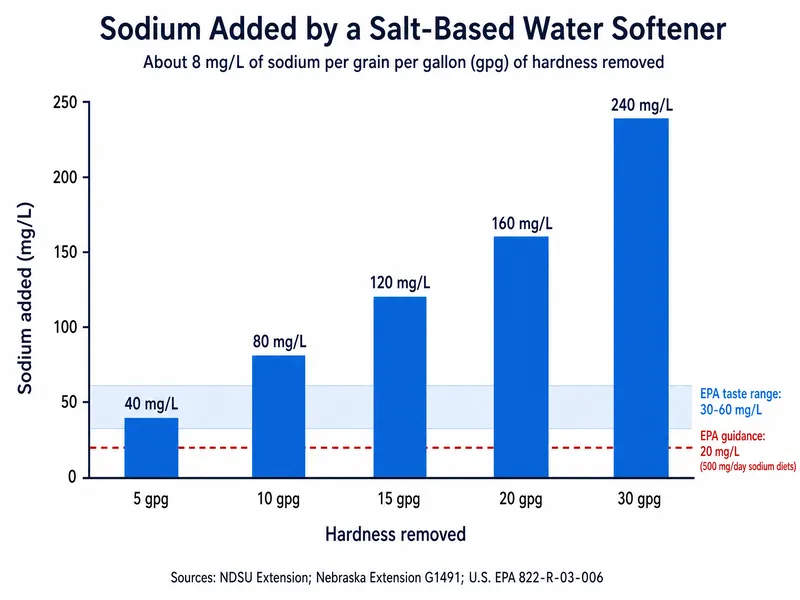
A salt-based softener adds about 8 mg/L of sodium for every grain per gallon of hardness it takes out. Nebraska Extension's NebGuide G1491 and NDSU give the same figure. The resin trades calcium and magnesium for sodium, so the harder the water was, the more sodium the softened water carries. EPA notes that home softeners can push sodium past 300 mg/L, which takes very hard water of about 37 gpg.
| Hardness removed | Sodium added | In 2 liters | Share of 2,300 mg |
|---|---|---|---|
| 5 gpg (86 mg/L) | 40 mg/L | 80 mg | 3% |
| 10 gpg (171 mg/L) | 80 mg/L | 160 mg | 7% |
| 15 gpg (257 mg/L) | 120 mg/L | 240 mg | 10% |
| 20 gpg (342 mg/L) | 160 mg/L | 320 mg | 14% |
| 30 gpg (513 mg/L) | 240 mg/L | 480 mg | 21% |
The table counts only what the softener adds. Your source water may already carry some sodium; a city's annual water quality report or a well test will show it.
How do you work out the sodium in your softened water?
Multiply your hardness in gpg by 8, then by the liters you drink and cook with each day.
- Find hardness. Use your utility's water quality report or a test; divide mg/L by 17.1 to get gpg. Our softener sizing guide explains the units.
- Multiply by 8. That is the added sodium in mg per liter.
- Multiply by daily liters. Two liters is a common planning figure; EPA uses it in its advisory.
Example: 14 gpg × 8 = 112 mg/L. At 2 liters a day, that is about 224 mg of added sodium, near 10% of 2,300 mg. An 8-ounce glass of 10 gpg softened water holds roughly 19 mg.
Who should be careful with softened drinking water?
Anyone told to limit sodium should ask their doctor before drinking softened water. NDSU and Nebraska Extension both say people on sodium-restricted diets should account for the extra sodium and consult their physician. EPA's 20 mg/L guidance applies to people held to 500 mg of sodium a day; softening just 2.5 gpg of hardness already adds that much. EPA also says people treated for sodium-sensitive high blood pressure should talk to their health care provider about another water source or point-of-use treatment.
For babies, ask your pediatrician before using softened water in formula. EPA's advisory notes that infants' kidneys are less effective than adults' at controlling sodium levels, which is reason enough to check rather than guess.
Potassium chloride is not automatically the safe swap. MedlinePlus lists kidney problems, ACE inhibitors and potassium salt substitutes among causes of high blood potassium, so people with kidney disease or on those medicines should ask their doctor first.
What does softening not remove from drinking water?
A softener is not a purifier. G1491 says softening "does not remove bacteria, hydrogen sulfide, silt or sand, lead, nitrate, pesticides," and Penn State Extension warns that softeners will not necessarily fix the more serious drinking water problems. If safety is the worry, test the water first and choose treatment for what the test finds. Our guide to whether you need a water softener covers testing.
How can you get low-sodium drinking water with a softener?
Three options keep softened water everywhere else:
- A bypass cold tap. NDSU says sodium from softened water "can be avoided by leaving one kitchen tap unsoftened for drinking and cooking." It is easiest to plumb at install time; our installation guide shows where the bypass sits.
- Reverse osmosis at the kitchen sink. Nebraska's NebGuide G1490 lists sodium among what household RO removes. Most units sit under the sink with their own faucet, and most recover only 20 to 30% of the water they take in; the rest goes to drain. On hard water, a softener ahead of RO can extend membrane life.
- Potassium chloride. The brine tank then adds potassium, not sodium. NDSU says it takes about 10% more and costs up to $25 per 40-lb bag; see salt vs potassium chloride.
For a household where only one person limits sodium, a bypass tap or RO usually costs less over time than running potassium through the whole house. Quality Water Treatment, which sells the SoftPro range, also sells RO systems. Pick the softener itself on hardness, flow and efficiency; our best water softeners roundup is the place to start, and city homes should also see best softeners for city water.
Common slip-ups
Treating softened water as purified
Softening targets calcium and magnesium. Test for anything else that worries you.
Ignoring very hard source water
At 30 gpg, softening adds about 240 mg/L. Do the math before drinking it daily.
Guessing about formula
Ask your pediatrician before softened water goes into a baby's bottle.
Watering plants from softened taps
NDSU advises against softened water on house plants, lawns and gardens because of the sodium.
Related guides
 GuidesWater softener salt vs potassium chloride
 GuidesHow does a water softener work?
 Best picksBest water softeners
 Water softener FAQ
How we put this page together
Sources: EPA's 2003 sodium advisory (EPA 822-R-03-006), FDA and MedlinePlus pages, NDSU Extension WQ1031, Nebraska Extension NebGuides G1274, G1490 and G1491, Penn State Extension and the USGS Water Science School, checked October 2026. This page is general information, not medical advice. We left out the old "7.5 to 8 mg/L" range, taste anecdotes and unsourced claims about formula guidance. No lab testing was done for this page.
Common questions
Does softened water taste salty?
Usually not. EPA says water with 30 to 60 mg/L of sodium is unlikely to taste salty to most people. Softening 10 gpg adds about 80 mg/L, so taste-sensitive people may notice on very hard water.
How much sodium is in a glass of softened water?
An 8-ounce glass is about 0.24 liters. At 10 gpg removed, that is roughly 19 mg of added sodium; at 20 gpg, about 38 mg.
Is softened water safe for babies?
Ask your pediatrician before using it for formula. A bypass tap or RO faucet gives unsoftened or low-sodium water for bottles.
Does a salt-free conditioner add sodium?
No. Salt-free devices do not remove hardness and use no salt, so sodium does not change. They also do not soften; see our salt-based vs salt-free guide.
Is it safe to cook with softened water?
For most people, yes. If someone in the home limits sodium, cook with water from a bypass tap or RO faucet, as NDSU suggests.
Does softening remove lead or bacteria?
No. Nebraska Extension lists bacteria, lead and nitrate among things softening does not remove. Use a water test to pick the right treatment.
Is hard water healthier to drink than soft water?
Nebraska Extension says hard water may supply a small amount of dietary calcium and magnesium, but neither hard nor softened water is a substitute for medical advice on minerals or sodium.
Comparing options? Start with our guide to choosing a water softener.