
Commercial
Water Softeners for Car Washes and Laundromats
Water softeners for car washes and laundromats remove the calcium and magnesium behind scale; car washes soften ahead of reverse osmosis for the spot-free rinse, and laundromats soften the washer and water heater feed.
By the Water Softener Reviews editors · Updated
Disclosure: watersofteners.reviews is run by the same team as SoftPro Water Systems and Quality Water Treatment, and we rank their products first. We compare published specifications, certifications, warranties and prices (as of October 2026). We did not lab-test these units. How we rank
On this page
- Why do car washes and laundromats use water softeners?
- How does a softener fit with reverse osmosis at a car wash?
- How much water does a car wash soften per day?
- How do you size a laundromat water softener?
- Which systems do we recommend for car washes and laundromats?
- Installation and upkeep for car washes and laundries
- Common questions
Key takeaways
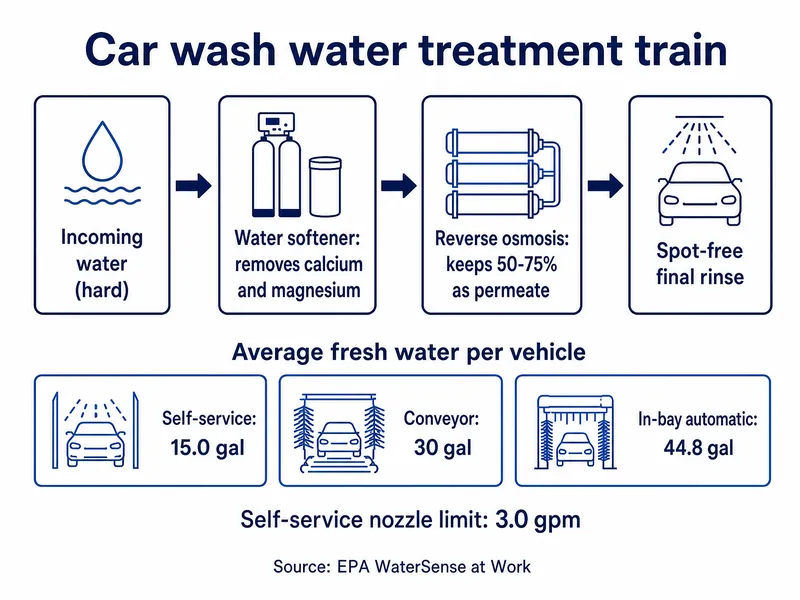
- EPA WaterSense at Work says facilities "often use water softeners" to pretreat water before other purification, such as the RO behind a spot-free rinse.
- Commercial RO units typically recover 50 to 75% of feed water, per the EPA, so the softener must treat more water than the rinse uses.
- Average fresh water per vehicle in the EPA's car-wash section: 15.0 gal self-service, 30 gal conveyor and 44.8 gal in-bay automatic (2018 study).
- Federal rules cap coin-operated front-load washers at an integrated water factor of 4.1 gallons per cycle per cubic foot.
- Pentair rates the 2-inch 2900S valve at 106 gpm and the 3-inch 3900 at 250 gpm continuous.
- QWT's SoftPro listing quotes a single car-wash case study claiming savings of 50% on salt, 47% on operating cost and up to 38% on water.
Car wash and laundry water figures
- 44.8 galIn-bay automatic average fresh water use per carEPA WaterSense at Work 5.4
- 50–75%Typical recovery of commercial reverse osmosis unitsEPA WaterSense at Work 7.1
- 4.1Maximum integrated water factor for coin-operated front-load washers (gal per cycle per cu ft)EPA WaterSense at Work 3.5
- 3.0 gpmRecommended nozzle limit for self-service wash baysEPA WaterSense at Work 5.4
Why do car washes and laundromats use water softeners?
Car washes and laundromats use water softeners to take out the calcium and magnesium that scale water heaters, boilers and membranes. Ion exchange swaps those minerals for sodium on resin beads; when the beads are spent, the valve backwashes, draws brine and rinses to drain. The how a water softener works walks through each step.
Hardness above 7 gpg (120 mg/L) is hard by the EPA's 2026 softener guide, and these businesses heat or purify large volumes of it. Boilers are a named case: the EPA's boiler guidance lists softeners, RO and demineralization as pre-treatment for make-up water.
How does a softener fit with reverse osmosis at a car wash?
The softener sits upstream of the RO system that makes spot-free rinse water. The EPA's water purification section says facilities often soften to pretreat water before other purification, and that pretreating feed water lets RO run at higher recovery. Its vehicle wash section lists RO or deionization for the wax and final rinse cycles, and asks operators to capture RO reject water for reuse in wash cycles.
Recovery sets the softener's load. At the EPA's typical 50 to 75% recovery, every 100 gallons of rinse water needs 133 to 200 gallons of softened feed.
How much water does a car wash soften per day?
Multiply cars per day by gallons per vehicle, then soften the lines that need it. The EPA's averages are 15.0 gallons per vehicle for self-service, 30 for conveyors and 44.8 for in-bay automatics in a 2018 industry study; for sites without a meter, makers estimate 75 gallons for conveyors and 55 for in-bay automatics.
Example assumptions for an in-bay automatic: 120 cars a day at 44.8 gallons is 5,376 gallons; at 20 gpg that is 107,520 grains a day. A duplex rated 300,000 grains per regeneration at maximum salt holds about 263,600 on a medium setting by Pentair's 5600SXT capacity data, about 2.5 days. Peak flow comes from the pump and RO specs; QWT lists its 2900S NXT2 systems at 40 to 100 gpm. Our commercial sizing guide works a self-service wash in full.
How do you size a laundromat water softener?
Size a laundromat softener from washers, cycles and the federal water factor. Since 2018, coin-operated front-loaders may use at most 4.1 gallons per cycle per cubic foot, so a 3.0 cu ft machine uses up to about 12.3 gallons a cycle.
Example assumptions: 30 washers, 8 cycles each a day, 14 gpg, open 6 a.m. to 10 p.m.
- Gallons per day: 30 × 8 × 12.3 = 2,952.
- Grains per day: 2,952 × 14 = 41,328.
- SoftPro single, 135,000 rated: about 118,600 grains on medium salt if rated at maximum, about 2.9 days.
- Fleck 2900S NXT2 single, 150,000 rated: about 131,800 on medium, about 3.2 days.
With eight closed hours, one tank can regenerate overnight; a 24-hour laundry needs twin-alternating. On-premise and industrial laundries differ: the EPA says washer-extractors use 2 to 4 gallons per pound and tunnel washers 2 or less.
| Business | Water need | Suggested setup | Example systems |
|---|---|---|---|
| Self-service bays | 15.0 gal per car, 3.0 gpm per bay | Twin-alternating | SoftPro duplex from $5,299; Fleck 9500 SXT twin from $5,779 (40 gpm) |
| In-bay automatic with RO | 44.8 gal per car, RO feed | Duplex or multi-tank | Fleck 2900S NXT2 duplex from $9,845; SoftPro triplex from $7,749 |
| Conveyor tunnel | 30 gal per car, high flow | Large duplex or quadraplex | Fleck 3900 NXT2 duplex from $17,100 (250 gpm); SoftPro quadraplex from $10,189 |
| Laundromat, closed overnight | up to 12.3 gal per cycle | Single tank | SoftPro single from $2,179; Fleck 2900S NXT2 single from $5,355 |
| 24-hour laundry | burst fills, no downtime | Twin-alternating | SoftPro duplex; Fleck 9500 SXT twin |
Salt is the big running cost. Using salt efficiency between 3,350 and 4,000 grains per pound and $5 to $10 a 40-lb bag, the car wash example uses about 806 to 963 lb a month ($101 to $241) and the laundromat 310 to 370 lb ($39 to $93). The commercial cost guide shows the method.
Which systems do we recommend for car washes and laundromats?
Our team's lines come first; each competitor has a real strength.
Systems for car washes and laundries
1. SoftPro Pro Series Commercial
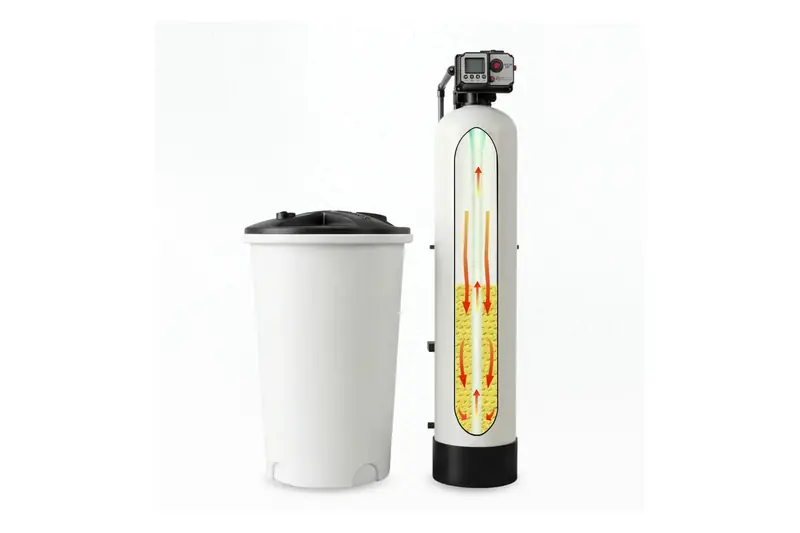
Laundromats that close at night can use a single; car washes can step up through duplex, triplex and quadraplex. Prices start at $2,179 (October 2026). SoftPro's progressive-flow design brings tanks on-line as demand rises. QWT's listing cites a car-wash case study with 50% salt savings. See our Pro Series write-up.
2. Pentair Fleck commercial, sold by QWT
Published flow and big capacity: 9500 SXT twin to 300,000 grains at 40 gpm, 2900S NXT2 singles reaching 600,000 grains with 40 to 100 gpm listed, 3900 NXT2 duplex to 1,200,000 grains at 250 gpm. From $1,448 (October 2026). See our Fleck commercial review.
3. US Water Systems (business line)
Priced online, with Fleck 2900, 3900, 9100 and 9500 lines and Synergy twin-alternating units. Its Fleck 2900 2-inch singles list at $4,680 to $11,220 (October 2026).
4. Culligan commercial
Quote-only through dealers. Culligan says its skidded Hi-Flo 3e comes in nearly 200 configurations, with multiple systems passing over 1,000 gpm at a stated 25 psi loss per system.
The ranking is on our best commercial water softeners page. To price a system, see the SoftPro Pro Series Commercial (sold by SoftPro, a store run by our team) or QWT's Pentair Fleck Commercial (sold by Quality Water Treatment, a store run by our team) listing; both offer free WISDOM sizing.
Installation and upkeep for car washes and laundries
Plan the drain, the salt and the testing before the equipment arrives:
- Backwash drain. Pentair lists 16 gpm for the 9500 valve and 100 gpm for the 3900 valve; the drain and any reclaim system must take it.
- Placement. Cold side, ahead of the water heater, boiler and RO. QWT lists the SoftPro Pro Series for 39 to 100 F.
- Pre-treatment. Red iron or a sulfur smell on well water needs a filter first; see our iron roundup.
- Salt handling. At 800-plus pounds a month, plan pallet storage near the brine tank.
- Testing. Check softened hardness ahead of the RO; hardness slipping through reaches the membranes.
Resin can be re-bedded rather than replaced with the system; see the resin replacement guide. The commercial water softeners buyer's guide covers layouts in more depth.
Related guides
 CommercialSizing a commercial softener
 CommercialCommercial water softener prices
 Best picksTwin tank softeners
 CommercialRestaurants and hotels
How we put this page together
This page relies on EPA WaterSense at Work's vehicle wash, laundry, boiler and water purification sections, the EPA WaterSense softener guide (May 2026), Pentair's valve pages and 5600SXT data sheet, all read in October 2026. SoftPro and QWT store listings supplied figures and prices for our team's products, and competitors' own sites supplied theirs. Detergent-savings claims and per-wash softened-water splits were left out because we found no primary source, and the 38/50/47% figures are one case study, not a general result.
Common questions
Does a car wash need a softener if it already has RO?
Usually. The EPA notes facilities often soften to pretreat water before other purification, and pretreatment helps RO run at higher recovery. Check your RO maker's feed-water limits.
How many gallons does a car wash soften a day?
Cars per day times gallons per car. At the EPA's 44.8-gallon in-bay average, 120 cars is 5,376 gallons, plus extra RO feed if recovery is 50 to 75%.
What water factor do laundromat washers have?
Coin-operated front-loaders built since 2018 must meet an integrated water factor of 4.1 gallons per cycle per cubic foot; top-loaders 8.8.
Will soft water cut detergent use in a laundromat?
We found no primary source that puts a number on it, so track detergent per load before and after softening rather than relying on a quoted percentage.
Can a softener feed a laundry boiler?
Yes. Softening boiler make-up water is one of the pre-treatment routes the EPA names, along with RO and demineralization. Keep a water treatment vendor on the boiler chemistry.
Single tank or twin for a car wash?
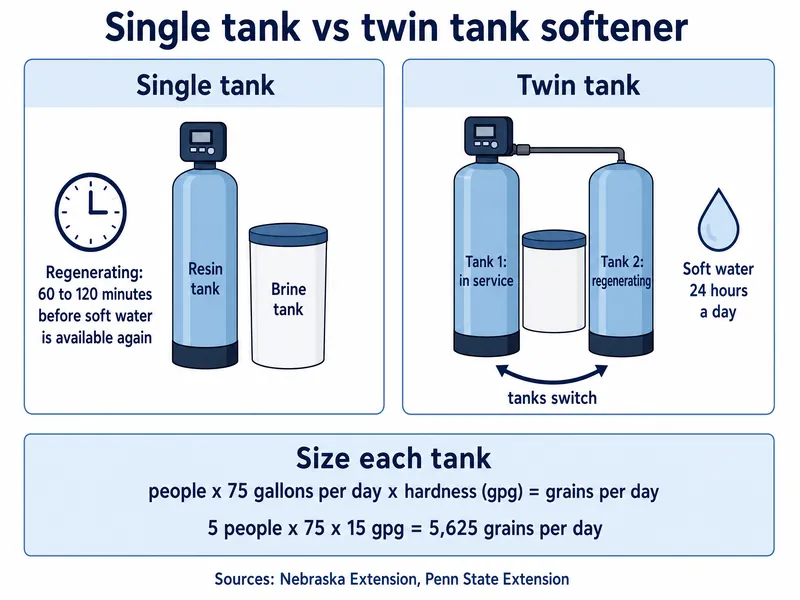
Most car washes refill RO storage at night or run long hours, so twin-alternating or multi-tank keeps soft water flowing while one tank regenerates.
How much salt does a car wash softener use?
Our 107,520-grain-a-day example uses about 27 to 32 lb a day, or 806 to 963 lb over 30 days, depending on salt efficiency.
Our pick
SoftPro Pro Series Commercial
Check current sizes and prices at SoftPro.
View at SoftProwatersofteners.reviews is run by the same team as SoftPro Water Systems and Quality Water Treatment, and we rank their products first. How we rank
Comparing options? Start with our water softener reviews.