
Guides
How Does a Water Softener Work?
How does a water softener work? It passes hard water through resin beads that trade sodium for calcium and magnesium, then recharges the full beads with salt brine and flushes the hardness down the drain.
By the Water Softener Reviews editors · Updated
On this page
- How does a water softener work, in plain terms?
- What happens inside the resin tank?
- How does a water softener regenerate, step by step?
- How long does water softener regeneration take?
- How much sodium does a water softener add?
- Is a salt-free conditioner a water softener?
- What trips people up
- Common questions
Key takeaways
- Softening is ion exchange: sulfonated polystyrene resin beads swap sodium for calcium and magnesium (Nebraska Extension G1491).
- A Fleck downflow valve regenerates in 4 stages (backwash, brine and slow rinse, rapid rinse, brine tank refill) before returning to service (Pentair SXT manual).
- Brining and flushing generally take 60 to 120 minutes, and a regeneration uses about 50 gallons of water (Penn State Extension).
- Softened water gains about 8 mg/L of sodium for every grain per gallon removed (NDSU Extension).
- Some softeners also remove up to 10 ppm of iron and manganese, within the maker's rating.
- Salt-free TAC conditioners convert hardness into crystals instead of removing it, so the water still tests hard (Nebraska Extension G2275).
How does a water softener work, in plain terms?
A water softener works by catching hardness minerals on resin and paying for them with sodium. Hardness is the dissolved calcium and magnesium in your supply, and the USGS notes that heated hard water drops calcium carbonate scale that can shorten water heater life and clog pipes.
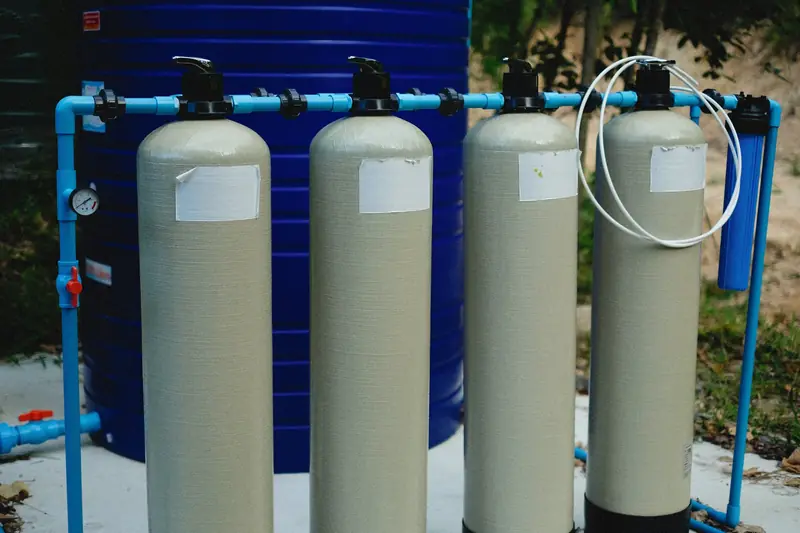
A salt-based system pairs a control valve on top of a tall resin tank with a separate brine tank; SoftPro's Elite, for example, ships with a valve, resin tank, brine tank and bypass valve. Water above 10.5 grains per gallon (180 mg/L) is classed as very hard, and 1 gpg equals 17.1 mg/L.
What the sources say
- 8 mg/Lsodium added per gpg of hardness removedNebraska Extension G1491
- 60–120 minfor brine to pass through and flush the tankNebraska Extension G1491
- 50 galwater used per regenerationPenn State Extension
- 0–199 minadjustable time for each Fleck SXT regeneration stepPentair Fleck SXT manual
- 10 ppmiron and manganese some softeners can also removeNDSU Extension WQ1031
What happens inside the resin tank?
Inside the tank, a bed of plastic beads holds sodium ions loosely, and calcium and magnesium push that sodium off as water moves through. NDSU describes the beads as looking like wet sand. Water leaving the bed is soft, and it carries the released sodium with it.
The bed has a fixed number of exchange sites, which is the grain rating on the box. A metered valve divides that capacity by the hardness you enter, counts gallons, and calls for a recharge before the beads run out. A timer valve recharges on a set number of days instead. Our sizing guide matches that rating to household use.
How does a water softener regenerate, step by step?
A water softener regenerates by reversing the exchange: a strong salt brine floods the beads, pushes calcium and magnesium off, and sends them to the drain. Pentair lists this order for its downflow Fleck valves.
| Stage | Flow | What it does |
|---|---|---|
| 1. Backwash | Up through the resin | Runs until the drain water is clear |
| 2. Brine and slow rinse | Down | Brine strips calcium and magnesium off the beads |
| 3. Rapid rinse | Down | Clears leftover brine |
| 4. Brine tank refill | To the brine tank | Adds water to dissolve salt for the next cycle |
| 5. Service | Down | Hard water in, soft water out |
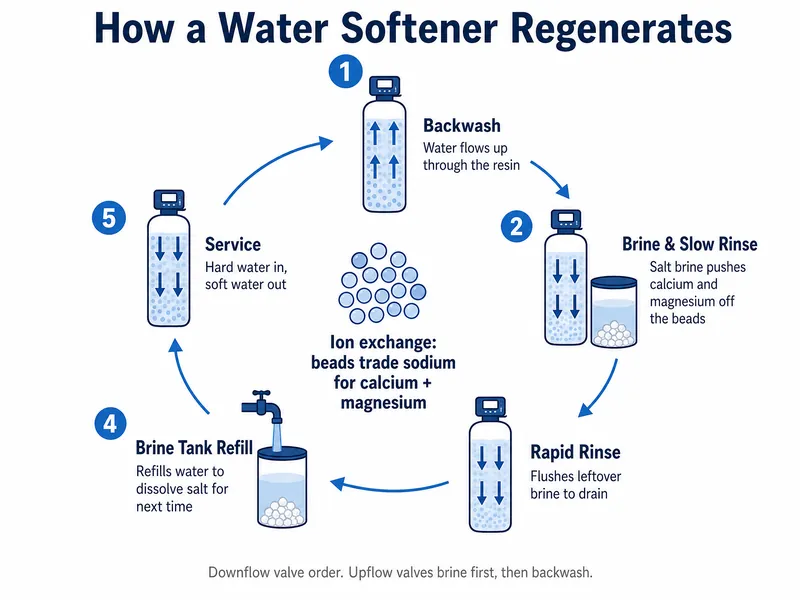
Upflow valves brine first and backwash second. SoftPro describes its city-water Elite as an upflow valve and its well-water Elite as a downflow valve. A twin-tank system keeps one resin tank in service while the other regenerates, so soft water never stops; see our twin tank picks.
How long does water softener regeneration take?
Expect one to two hours. Nebraska Extension says 60 to 120 minutes are generally needed for the brine to pass through and flush the tank before soft water is available again. On a Fleck SXT each step is programmable from 0 to 199 minutes, and installers set them per job.
Water use varies by valve. Penn State and Nebraska both put a regeneration at about 50 gallons. QWT states the Fleck 5600SXT uses about 12 gallons per cycle. The regeneration time is programmable; the SXT manual shows 2:00 as its example setting.
How much sodium does a water softener add?
A water softener adds about 8 mg of sodium per liter for each grain per gallon of hardness it removes, so 10 gpg water ends up near 80 mg/L. The exchange is close to one for one, which is why harder water means more sodium. Our soft water drinking guide covers diets and infant formula.
Potassium chloride avoids added sodium. NDSU notes that about 10% more of it is used per regeneration, and Nebraska adds that it holds to resin more strongly. Compare costs in our salt vs potassium guide.
Is a salt-free conditioner a water softener?
No. Template-assisted crystallization (TAC) uses surface-treated beads to convert hardness into microscopic crystals that resist forming scale, and Nebraska Extension calls these descalers because they do not remove hardness.
| Item | Ion exchange softener | TAC conditioner |
|---|---|---|
| Removes calcium and magnesium | Yes | No, converts them to crystals |
| Water tests soft afterward | Yes | No |
| Uses salt and a drain | Yes | No |
| Handles iron and manganese | Small amounts, per maker rating | Generally not; may need pretreatment |
Nebraska also notes that few conclusive studies confirm how well these devices work in homes. Our salt-based vs salt-free comparison covers the trade-offs.
What trips people up
Expecting it to fix everything
Penn State notes colorless iron is removed but red, oxidized iron clogs resin. Sulfur odor or iron bacteria need their own filter upstream; see our iron guide.
Guessing the hardness number
The meter math depends on the hardness entered. Test the water, or ask your public water system, which monitors hardness.
Mixing up softening and descaling
A salt-free descaler leaves hardness in the water, so a hardness strip will not show a change. Resin upkeep is in our resin replacement guide.
Related guides
Common questions
Does a water softener remove salt from water?
No. It removes calcium and magnesium and releases sodium in their place. At normal hardness the water does not taste salty, but roughly 8 mg/L of sodium per gpg removed is there.
How often does a water softener regenerate?
A metered valve regenerates when its calculated capacity is used up, and a day-override setting caps the days between cycles. SoftPro states its well-water Elite regenerates about every 4 to 7 days depending on water use.
What happens if the power goes out during regeneration?
On a Fleck SXT the valve saves its position and finishes the cycle when power returns. The control keeps time for at least 48 hours during an outage.
Does softened water still test hard?
Not from a working ion exchange softener: hardness drops into the soft range. Water from a TAC conditioner still tests hard because the minerals stay in it.
Can a softener remove iron?
Some can remove up to 10 ppm of iron and manganese. Nebraska Extension warns that iron above 5 ppm or hydrogen sulfide can reduce softener performance, so check the maker's rating.
Why does my softener need a drain line?
Backwash, brine rinse and rapid rinse all send water and the stripped hardness to drain. Plan for about 50 gallons per cycle.
How we put this page together
This page is based on Nebraska Extension NebGuides G1491 and G2275, NDSU Extension WQ1031, Penn State Extension's water softening fact sheet, the USGS hardness page and Pentair's Fleck SXT service manual, all checked in October 2026. Product statements come from the makers' own pages. We left out stage-by-stage minutes (Pentair publishes only a programmable range), salt pounds per cycle, forum anecdotes and any lab testing of our own.
Comparing options? Start with our water softener reviews.