
Guides
Water Softener Resin Replacement
Water softener resin replacement means emptying the resin tank and refilling it with fresh beads, about 1 cubic foot per 32,000 grains of rated capacity, once hardness keeps slipping through after regeneration.
By the Water Softener Reviews editors · Updated
On this page
Key takeaways
- SoftPro sizes replacement resin at 0.75 cubic feet for a 24,000-grain softener, 1 cubic foot for 32,000 and 2 cubic feet for 64,000.
- Resin maker Purolite says each 1 ppm of chlorine cuts softening resin life by 50%, and higher cross-linking resists that attack better.
- SoftPro and Quality Water Treatment both recommend 10% cross-link resin for chlorinated city water.
- As of October 2026, 8% resin starts at $130 per cubic foot and 10% resin at $181.15 per cubic foot on SoftPro.
- Penn State Extension notes that some fouled resin cannot be washed clean and must be replaced.
- EPA WaterSense says resin beads need cleaning annually, which delays replacement.
When does water softener resin need replacing?
Replace the resin when the water tests hard soon after each regeneration even though salt is being drawn and the settings are right. Other signs are a softener that regenerates more often for the same household, falling water pressure through the unit, and beads in faucet aerators.
Rule out the cheaper causes first. The Fleck 5600SXT service manual lists an open bypass, no salt, a plugged injector screen, low brine refill and a cracked distributor tube as causes of hard water. A salt bridge, which EPA WaterSense says you can break up with a broom handle, is another. Our guide to how long water softeners last covers which parts fail first.
What the sources say
- 1 cu ftresin for a 32,000-grain softenerSoftPro resin listing (a store run by our team)
- 31,100grains from 1.0 cu ft of resin at 9 lb of saltPentair 5600SXT manual
- 50%cut in resin life for each 1 ppm of chlorinePurolite
- 1.2 fl oz5.25% bleach per cu ft of resin to sanitizePentair 5600SXT manual
What does resin do, and why does it wear out?
Resin is the working part of a salt-based softener: plastic beads hold sodium and swap it for calcium and magnesium, then brine recharges them. Our page on how a water softener works covers the cycle. The beads are not used up like salt, but they wear.
Oxidizers are the main threat. Purolite says all oxidizing chemicals attack the cross-linking of the resin backbone, that resin life drops by half for every 1 ppm of chlorine, and that 0.3 ppm does little harm in cold water. Iron is the second: softening resin holds iron strongly, so it builds up and cuts capacity, and it speeds chlorine damage too. Penn State adds that red, oxidized iron clogs resin.
Should you choose 8% or 10% cross-link resin?
Choose 10% cross-link resin on chlorinated city water and standard 8% on most wells without chlorine. Cross-link describes how tightly each bead's polymer is bonded; Purolite says more cross-linking means more resistance to oxidation, and that some low-priced resins use 6% or less.
| Resin | Best for | What the store says | Price as of Oct 2026 |
|---|---|---|---|
| 8% cross-link (Aquafine AQ100-NA) | Well water without chlorine | Standard gel polystyrene cation resin; WQA Gold Seal certified against NSF/ANSI 61 | From $104 (0.75 cu ft) at SoftPro |
| 10% cross-link (Aldex Premium) | Chlorinated city water | SoftPro recommends it for city water that contains chlorine | From $132.55 (0.75 cu ft) at SoftPro |
| 10% cation premium | Chlorinated city water | QWT says it is much more durable towards chlorine and iron | From $205.83 (1 cu ft) at QWT |
| Fine mesh (Aquafine) | Well water with iron | Sold for removing iron from well water | From $193.33 (1 cu ft) at SoftPro and QWT |
NSF/ANSI 61 is a materials-safety standard, not a performance rating. QWT also claims 10% resin lasts twice as long as 8%; that is a store claim we could not check against a primary source.
Fine mesh resin uses smaller beads. SoftPro states the fine mesh resin in its ECO Well softener is engineered to capture dissolved iron better than standard resin. It does not fix red water or rotten-egg odor; those need a filter upstream, covered in our iron and sulfur picks.
How much resin should you order?
Order the volume the tank held, which matches the softener's grain rating. SoftPro's replacement listings pair each size with a softener rating, and QWT's Fleck listings give the matching tank sizes.
| Rated capacity | Resin | Mineral tank (Fleck at QWT) |
|---|---|---|
| 24,000 grains | 0.75 cu ft | 8 x 44 in |
| 32,000 grains | 1.0 cu ft | 9 x 48 in |
| 40,000 grains | 1.25 cu ft | 10 x 44 in |
| 48,000 grains | 1.5 cu ft | 10 x 54 in |
| 64,000 grains | 2.0 cu ft | 12 x 52 in |
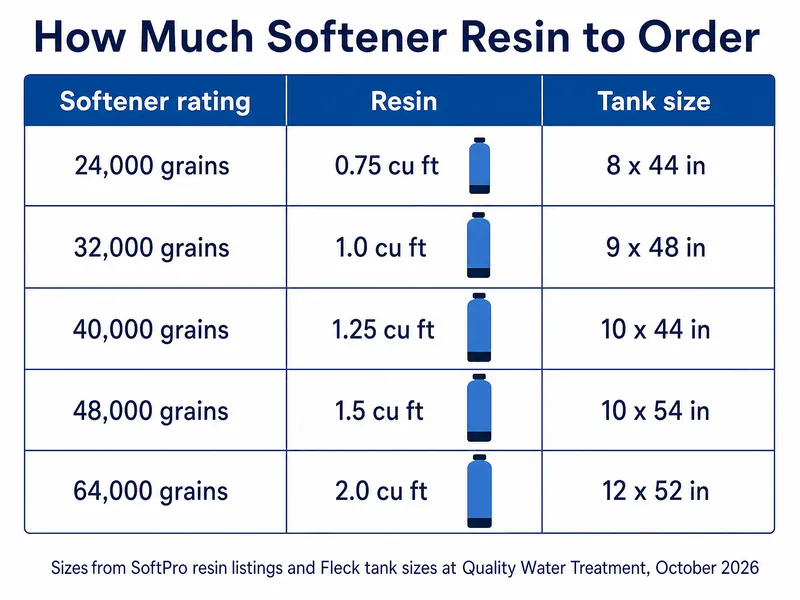
Ratings assume a heavy salt dose. The Pentair 5600SXT manual rates 1.0 cubic foot at 11,900 grains on 3 lb of salt and 31,100 grains on 9 lb, so an efficient setting delivers less. If your household has grown, our sizing guide shows whether to step up a tank size.
How to replace water softener resin, step by step
Re-bedding takes basic tools: a shop vac or siphon hose, a funnel, tape, silicone grease and heavy trash bags. These steps follow QWT's SoftPro Elite resin guide and SoftPro's resin replacement article (SoftPro, a store run by our team); your manual comes first.
- Bypass the softener. Turn the bypass handles to bypass.
- Relieve pressure. QWT starts a manual regeneration and lets backwash or rinse run for 2 minutes, then steps the valve back to service.
- Unplug and disconnect. Remove the drain line, brine line and bypass, then unscrew the valve from the tank.
- Empty the tank. Siphon the water or use a shop vac over the center tube, then dump the old resin into heavy bags and rinse the tank.
- Inspect the distributor tube. A cracked tube or basket sends beads into the plumbing; replace it if damaged.
- Cover the tube and add gravel if used. Tape over the center tube's opening. SoftPro adds a small layer of softener gravel to protect the distributor basket where the tank used it.
- Pour in the resin. Use a funnel, keep the tube centered and do not overfill.
- Refit the valve. Remove the tape, grease the O-rings with silicone only, as Pentair specifies, and thread the valve on by hand.
- Reconnect and fill slowly. Pentair warns that opening the water fast can push media out of the tank.
- Backwash and sanitize. SoftPro says to run a backwash to rinse out fines, then sanitize with bleach or a resin cleaner per the maker. Re-enter capacity if you changed resin volume.
Avoid these
Buying the cheapest bead
Purolite says resins with 6% cross-link or less resist oxidation least.
Overfilling the tank
Resin needs room to lift during backwash. SoftPro's guide says fill only to the maker's level.
Skipping the distributor check
A cracked tube sends new beads into your plumbing.
Ignoring the cause
If chlorine or iron wrecked the old bed, add a carbon or iron filter first.
Re-bed or replace the whole softener?
Re-bed when the valve is healthy and the tanks are sound; resin for a 32,000-grain unit runs about $130 to $206 per cubic foot as of October 2026. If the valve is old or parts are hard to find, a new system can make more sense. On city water, look for 10% resin plus carbon pre-filtration in our best softeners for city water; on a well with clear-water iron, see the best softeners for well water. For a full replacement, start with our best water softeners roundup.
Related guides

Common questions
How often does softener resin need replacing?
There is no fixed calendar. Purolite says premium resin can run over ten years in a well-designed system, while chlorine and iron can shorten that a lot. Replace it when testing shows hardness breaking through.
Can new resin go on top of old resin?
It is rarely worth it. Worn beads stay in the bed, keep restricting flow and drag down capacity, so empty the tank and start fresh.
How much does replacement resin cost?
As of October 2026, SoftPro lists 8% resin at $130 and 10% resin at $181.15 for 1 cubic foot; QWT lists 10% at $205.83. Fine mesh costs $193.33 per cubic foot at both.
Is 10% cross-link resin always better?
It resists chlorine better, which matters on city water. On a well without chlorine, 8% resin is the standard choice and costs less.
Will new resin fix iron staining?
Fine mesh resin helps with dissolved, clear-water iron. Red water, iron bacteria and sulfur odor need a dedicated filter ahead of the softener.
Does the valve need reprogramming after re-bedding?
Check it. If you changed resin volume, update the capacity setting so the softener regenerates on time.
How do you keep new resin lasting longer?
Clean it yearly with a maker-approved cleaner, as EPA WaterSense advises, and filter out chlorine and iron before the softener.
How we put this page together
This page is based on Purolite's guidance on softening resin life, Penn State Extension, EPA WaterSense's softener guide, Pentair's 5600SXT manual, the Fleck 5600SXT service manual, and SoftPro and Quality Water Treatment resin listings and re-bedding guides, all checked in October 2026. Prices are from the store pages on October 23, 2026. We dropped the common "10 to 15 years" resin life and the "30,000 grains per cubic foot" rule because no primary source supports them in that form. We left out forum advice and any testing of our own.
Comparing options? Start with our water softener buying guide.