
Commercial
How to Size a Commercial Water Softener
For commercial water softener sizing, match the valve's rated flow to your peak gpm, then cover gallons per day times hardness with the grains the tank holds at your salt setting.
By the Water Softener Reviews editors · Updated
Disclosure: watersofteners.reviews is run by the same team as SoftPro Water Systems and Quality Water Treatment, and we rank their products first. We compare published specifications, certifications, warranties and prices (as of October 2026). We did not lab-test these units. How we rank
On this page
- What are the steps to size a commercial water softener?
- Why does peak flow come before grains?
- How many gallons a day does a business soften?
- How does salt setting change commercial softener capacity?
- Worked examples: a kitchen, a hotel and a car wash
- When does a business need twin or multi-tank softening?
- Which systems fit these commercial softener sizes?
- Common questions
Key takeaways
- Grains per day = gallons softened per day × hardness in gpg (1 gpg = 17.1 mg/L). Penn State Extension uses the same arithmetic.
- Flow comes first: Pentair rates its 9500 valve at 38 gpm and its 3-inch 3900 valve at 250 gpm continuous.
- Salt setting changes capacity: on Pentair's 5600SXT data, 1 cu ft of resin holds 11,900 grains on 3 lb of salt and 35,400 on 15 lb.
- Iron counts as hardness: each ppm of ferrous iron adds 5 gpg in the A. O. Smith softener manual.
- The EPA's WaterSense at Work guide recommends demand-initiated softeners and "multiple smaller" alternating units for uninterrupted soft water.
- One EPA case-study hotel used 132 gallons per occupied room per day after its retrofit.
Numbers behind commercial sizing
- 38 gpmContinuous service flow of the Fleck 9500 valvePentair
- 34%Lean-salt capacity as a share of maximum-salt capacity (11,900 vs 35,400 grains per cu ft)Pentair 5600SXT data sheet
- 3,500Grains per pound of salt that EPA says efficient softeners can reachEPA WaterSense at Work 7.1
- 132 galWater per occupied room per day at one retrofitted hotelEPA WaterSense case study
What are the steps to size a commercial water softener?
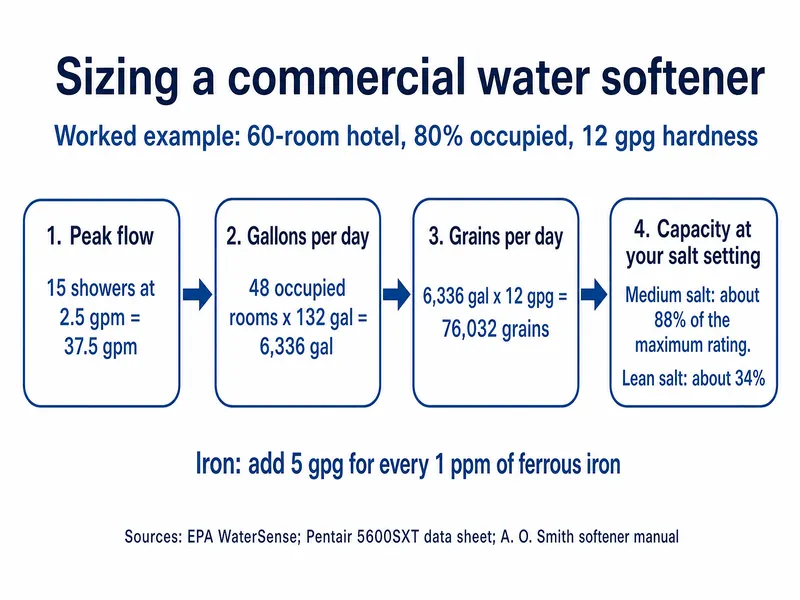
You size a commercial water softener in four steps: peak flow, gallons per day, grains per day, then capacity at the salt dose you will run. Flow picks the valve and tank diameter; grains pick the resin volume and how often it regenerates.
- Peak flow (gpm). Add everything that can draw softened water in the same minute.
- Gallons per day. Read the meter on the line you plan to soften, or build it from equipment specs.
- Grains per day. Gallons × hardness in gpg. Convert lab results at 1 gpg = 17.1 mg/L, as in Penn State Extension's softening guide. Add 5 gpg per ppm of ferrous iron.
- Usable capacity. Ask which salt dose the grain rating assumes, then divide usable grains by grains per day to get days per tank.
Why does peak flow come before grains?
A softener with plenty of grains still fails if water cannot pass through it fast enough. Too much flow drops pressure at the fixtures and pushes hardness through the resin before it is exchanged. Valve ratings tell you where the ceiling is.
Pentair's valve pages rate the valve, not a finished system. Its 9500 valve page lists 38 gpm continuous with a 16 gpm backwash, while QWT lists its 9500 SXT twin systems at 40 gpm. The 2-inch 2900S valve is rated at 106 gpm alone, but QWT lists its 2900S NXT2 systems at 40 to 100 gpm, depending on the tanks paired with it. Use the system figure.
Peak flow is the sum of fixtures running together. The EPA lists standard showerheads at 2.5 gpm, federal pre-rinse spray valves at 1.00 to 1.28 gpm, and its car-wash guidance caps self-service nozzles at 3.0 gpm.
How many gallons a day does a business soften?
Your own meter is the best number; equipment specs fill the gaps. These are the published figures we use in the examples below.
| Use | Figure | Source |
|---|---|---|
| Hotel, after fixture retrofit | 132 gal per occupied room per day (202 before) | EPA WaterSense case study |
| ENERGY STAR high-temp dish machine | 0.54 to 0.89 gal per rack maximum | EPA WaterSense at Work 4.10 |
| Standard steam cooker | up to 40 gal per hour (efficient: 5 or less) | EPA WaterSense at Work 4.4 |
| Self-service car wash | 15.0 gal per vehicle average | EPA WaterSense at Work 5.4 |
| In-bay automatic car wash | 44.8 gal per vehicle average (2018 study) | EPA WaterSense at Work 5.4 |
| Washer-extractor laundry | 2 to 4 gal per lb of laundry | EPA WaterSense at Work 3.5 |
Soften only the lines that need it. Restaurants often skip drinking taps and ice machines that have their own filter spec; hotels often soften the whole building.
How does salt setting change commercial softener capacity?
Every grain figure assumes a particular salt dose, and efficient doses deliver far fewer grains. Pentair's 5600SXT data sheet gives the curve for 1 cu ft of resin.
| Setting | Salt per cu ft | Grains | Share of maximum |
|---|---|---|---|
| Lean | 3 lb | 11,900 | about 34% |
| Medium | 9 lb | 31,100 | about 88% |
| Maximum | 15 lb | 35,400 | 100% |
If a commercial rating assumes maximum salt, plan on about 88% of it at a medium setting and about 34% at the lean setting, which Pentair rates at 4,400 grains per pound. The EPA's water purification guidance points buyers to systems reaching at least 3,500 grains per pound and no more than 4 gallons of regeneration water for each 1,000 grains.
Worked examples: a kitchen, a hotel and a car wash
The inputs below are example assumptions; the per-unit water figures come from the EPA sources in the table above.
Restaurant kitchen, 18 gpg, closed overnight. A dish machine running 200 racks at 0.89 gal (178 gal), a pre-rinse valve at 1.28 gpm for 2 hours (154 gal) and an efficient steam cooker at 5 gal an hour for 10 hours (50 gal) total about 382 gal. That is 382 × 18 = 6,876 grains a day. A single tank rated 81,000 grains at maximum salt holds about 27,200 lean (4 days) or 71,200 medium (10 days), so one tank regenerating after close is enough.
60-room hotel, 12 gpg, open 24 hours. At 80% occupancy, 48 rooms × 132 gal = 6,336 gal a day, or 76,032 grains. If 15 showers run at once at 2.5 gpm, peak flow is 37.5 gpm. A 300,000-grain twin holds about 263,600 grains per regeneration on medium salt, about 3.5 days. But 37.5 gpm sits at the 9500 valve's 38 gpm rating, so a 2-inch-class system leaves headroom.
Self-service car wash, 6 bays, 20 gpg plus 0.5 ppm iron. Compensated hardness is 20 + (0.5 × 5) = 22.5 gpg. Two hundred cars at 15.0 gal is 3,000 gal, or 67,500 grains a day. Six nozzles at 3.0 gpm give an 18 gpm peak, plus the RO feed. A 150,000-grain twin lasts about 2 days per tank on medium salt.
| Site | Gallons/day | Hardness (gpg) | Grains/day | Peak flow | Layout |
|---|---|---|---|---|---|
| Restaurant kitchen | 382 | 18 | 6,876 | per equipment specs | Single tank |
| 60-room hotel | 6,336 | 12 | 76,032 | 37.5 gpm | Twin, 2-inch class |
| Self-service car wash | 3,000 | 22.5 | 67,500 | 18 gpm + RO feed | Twin-alternating |
When does a business need twin or multi-tank softening?
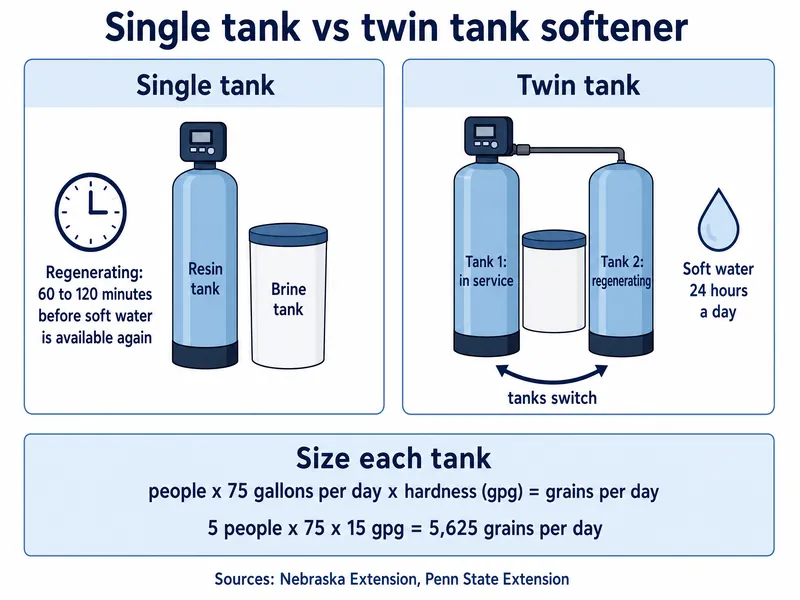
You need twin or multi-tank softening when water runs during the hours a single tank would regenerate, or when peak flow is beyond one valve. The EPA's guidance suggests "multiple smaller, more efficient" softeners that alternate, to cut regeneration frequency and keep soft water flowing. A restaurant closed overnight can regenerate one tank after close; a hotel or a car wash refilling RO storage overnight cannot. Our twin tank roundup explains alternating designs, and the hotel and restaurant guide and car wash and laundromat guide cover each trade.
Iron changes the plan. Ferrous iron adds 5 gpg per ppm in A. O. Smith's softener manual; oxidized iron or sulfur needs a filter first (see our iron roundup).
Which systems fit these commercial softener sizes?
The commercial lines from both of our team's stores cover the three examples; they publish different things.
Systems that fit these sizes
SoftPro Pro Series (our first pick)
Four layouts (single through quadraplex) up to 270,000 grains; the smallest single is $2,179 (October 2026). SoftPro does not publish flow per model; its metering detects flows under 1 gpm, and its free WISDOM tool and a manual order review check sizing. See the SoftPro Pro Series review.
Pentair Fleck commercial from QWT (second)
QWT publishes system flows for each valve family, from 20 gpm on the 9100 SXT twin (9 gpm for its 8x44 package) up to 250 gpm on the 3900 NXT2. From $1,448 as of October 2026. See the Pentair Fleck commercial review.
US Water Systems and Culligan
US Water Systems lists a 1-inch Matrixx Bluetooth commercial unit at "up to 25 gpm (13 gpm continuous)". Culligan sells through dealers by quote, with skidded high-flow systems.
The full order is on our best commercial water softeners list, and prices for each layout are in the commercial cost guide. To run your numbers against the first pick, open the SoftPro Pro Series Commercial (sold by SoftPro, a store run by our team) page and its WISDOM tool.
Before ordering, check the drain against backwash: Pentair lists 16 gpm for the 9500 and 100 gpm for the 3900. QWT lists the SoftPro Pro Series for 20 to 100 psi and 39 to 100 F, so it belongs on the cold feed. Homes should use the residential water softener sizing guide, and the commercial buyer's guide covers installation.
Related guides
 CommercialBuying a commercial softener
 CommercialCommercial water softener cost
 GuidesHow resin and brine soften water
 Best picksBest twin tank water softeners
How we put this page together
Sources: EPA WaterSense at Work sections 3.5, 4.4, 4.10, 5.4 and 7.1, an EPA WaterSense hotel case study, EPA pages for showerheads and pre-rinse spray valves, Penn State Extension, Pentair valve pages and the 5600SXT data sheet, and A. O. Smith's softener manual, checked October 2026. Product facts and prices come from the SoftPro and QWT store pages. We left out rules of thumb with no primary source, including a manganese factor and a fixed "usable percentage" of rated capacity, and we did no testing.
Common questions
How many grains per day does a business remove?
Take daily softened gallons times gpg. A kitchen softening 382 gallons of 18 gpg water removes 6,876 grains a day; a 60-room hotel using 6,336 gallons of 12 gpg water removes 76,032.
Is the valve's flow rating the same as the system's?
No. Pentair rates the 2-inch 2900S valve alone at 106 gpm, while QWT lists its 2900S NXT2 systems at 40 to 100 gpm depending on tank size. Size to the system figure at your peak.
How long should a commercial tank run between regenerations?
Long enough to regenerate at efficient settings, not several times a day. The EPA favors demand-initiated softeners that regenerate on gallons used or hardness rather than a fixed schedule.
Does a commercial grain rating assume maximum salt?
Often, so ask. On Pentair's data, 1 cu ft of resin gives 35,400 grains on 15 lb of salt but 11,900 on 3 lb, about a third.
How much water does a commercial softener use to regenerate?
EPA's efficiency benchmark is 4 gallons per 1,000 grains at most. At that rate the hotel example, at 76,032 grains a day, sends about 304 gallons a day to drain.
Can one softener serve a kitchen and guest rooms?
Yes, if it is sized for the combined peak flow and daily grains. Many hotels soften the whole building on a twin system and leave a drinking tap unsoftened.
What hardness makes a business softener worthwhile?
The EPA's 2026 softener guide treats water above 120 mg/L (7 gpg) as hard, and notes that softening is commonly advised once hardness passes 180 mg/L (10 gpg).
Our pick
SoftPro Pro Series Commercial
Check current sizes and prices at SoftPro.
View at SoftProwatersofteners.reviews is run by the same team as SoftPro Water Systems and Quality Water Treatment, and we rank their products first. How we rank
Comparing options? Start with our best water softeners and reviews.