
Best picks
Best Water Softeners for City Water
The best water softener for city water in 2026 is the SoftPro ECO city model, from $967 alone or $2,047 with a Gold carbon filter for chlorine and chloramine (October 2026).
By the Water Softener Reviews editors · Updated
Disclosure: watersofteners.reviews is run by the same team as SoftPro Water Systems and Quality Water Treatment, and we rank their products first. We compare published specifications, certifications, warranties and prices (as of October 2026). We did not lab-test these units. How we rank
On this page
- Which is the best water softener for city water?
- How did we rank city water softeners?
- #1 SoftPro ECO (city)
- #2 SoftPro Elite Smart HE (city)
- The rest of the city water list
- Does city water need a softener at all?
- Why put a carbon filter before a city water softener?
- What size softener does a city home need?
- Common questions
Key takeaways
- SoftPro ECO (city) ranks first: built for 3/4-inch plumbing in 32k, 48k or 64k grains, from $967, or $2,047 with the Gold carbon package (Oct 2026).
- SoftPro Elite Smart HE (city) is second, with an upflow valve and four sizes from $1,367; SoftPro says it averages one regeneration about every 14 days.
- The EPA requires utilities to send customers an annual water quality report by July 1, which is where city homes find their hardness.
- EPA caps chlorine and chloramine in tap water at 4.0 mg/L, and more than 1 in 5 Americans drink water treated with chloramines.
- The A. O. Smith softener manual lists a maximum chlorine level of 0 ppm for its softeners, one reason to put carbon ahead of the resin.
- EPA WaterSense treats 7 gpg (120 mg/L) as the start of hard water and 10 gpg as the point where a softener is commonly advised.
Which is the best water softener for city water?
For most homes on a public supply it is the SoftPro ECO city model, then the SoftPro Elite city model. Municipal water rarely carries iron or grit, so the job is to remove hardness and keep the utility's disinfectant away from the resin, and every pick below either sells a carbon stage or is judged on how easily one is added.
| Rank | System | Suits | Grains | Lowest price, Oct 2026 |
|---|---|---|---|---|
| #1 | SoftPro ECO (city) | Most city homes, 3/4-inch plumbing | 32,000–64,000 | $967 |
| #2 | SoftPro Elite Smart HE (city) | 1-inch plumbing, larger households | 32,000–64,000 | $1,367 |
| #3 | SpringWell SS | High flow, many bathrooms | 32,000–80,000 | $1,606.50 |
| #4 | Aquasana Rhino + Salt-Free Conditioner | Chlorine filtering plus scale control without salt | No grain rating; filter rated 1,000,000 gal | $3,546 ($1,998 + $1,548) |
How did we rank city water softeners?
Three things decided the order: how each seller handles disinfectant, the softener itself, and the full price of softener plus carbon. For disinfectant we asked whether a carbon bundle exists, what the seller says it removes, and whether that claim belongs to the filter or the softener. For the softener we compared valve type, resin crosslink and the size range a typical city household needs.
We never credit a softener with chlorine removal it does not claim. Where SoftPro describes chloramine, PFAS or fluoride reduction, those claims belong to its Gold and Gold+ filters. If you would rather skip salt, our salt-free picks explain the trade: conditioners limit scale but leave the water hard.
#1 SoftPro ECO (city)
The ECO city model is SoftPro's lower-cost softener for homes with 3/4-inch plumbing, sold in 32k, 48k and 64k sizes from $967 as of October 2026. Its programmable valve regenerates on demand, runs a 15-minute refresh when remaining capacity drops below 3%, keeps a 15% auto reserve and holds its settings for 48 hours in an outage. SoftPro rates the 8% crosslink resin at up to 20 years under normal use.
The Gold package is the reason it leads a city list. Gold adds SoftPro's Chlorine+ catalytic carbon filter, from $2,047 with the 32,000-grain softener; Gold+ adds bone char for fluoride, from $2,217. SoftPro states the Gold filter removes up to 98% of contaminants including chlorine, chloramine, heavy metals, pesticides and PFAS. That is a filter claim, and the filter sits ahead of the softener so the resin only meets dechlorinated water.
The valve gets 10 years of coverage while both tanks get lifetime limited cover, plus lifetime technical support and a 6-month money-back guarantee. SoftPro claims a 10% salt cut against traditional units, and it arrives with the bypass already fitted. For 1-inch plumbing or high flow, SoftPro itself points buyers to the Elite. More in our SoftPro ECO review.
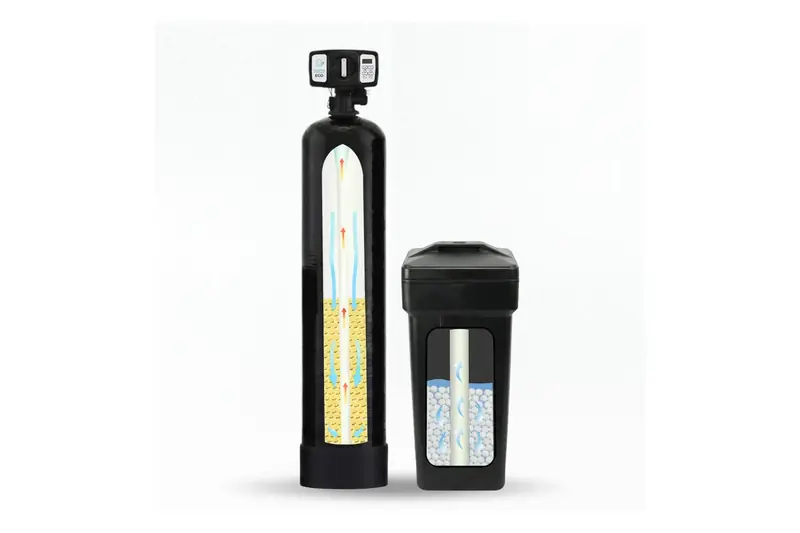
Best for most city homes
SoftPro ECO (city)
- Capacity: 32k, 48k or 64k grains on 8% crosslink resin
- Price (Oct 2026): from $967; Gold carbon package from $2,047
- Coverage: tanks lifetime limited, control valve 10 years
- Why it ranks here: the lowest price for a metered softener plus a matched chlorine and chloramine filter from one seller
View at SoftProSold by a store run by the same team as this site. How we rank
#2 SoftPro Elite Smart HE (city)
The Elite city model steps up to an upflow control valve with upflow regeneration, in four sizes (32k, 40k, 48k, 64k) from $1,367 as of October 2026. SoftPro lists 10% high-capacity resin, vacation mode, a 15% auto reserve, soft-water brine refill and 48-hour backup. Two city-specific claims stand out: it can skip up to 10 backwash cycles on clean city water, and the average unit regenerates about every 14 days.
The same carbon options apply. With the 32,000-grain softener, Gold (Chlorine+) is $2,447 and Gold+ is $2,607; SoftPro's bundle text says Gold removes chlorine, chloramines, chemical byproducts, VOCs and PFAS; again, that describes the filter. SoftPro credits precision brining with up to 30% more salt saved and expects a 40-lb bag to last a typical household 2 to 4 months.
It ranks second because most city homes can skip the extra $400: the ECO already fits 3/4-inch plumbing and takes the same carbon bundle. The Elite earns its price in bigger homes, on 1-inch lines, or for buyers who want lifetime limited coverage on the valve itself rather than 10 years. SoftPro puts a DIY install at 2 to 3 hours, or $150 to $300 for a handyman. See the SoftPro Elite review.
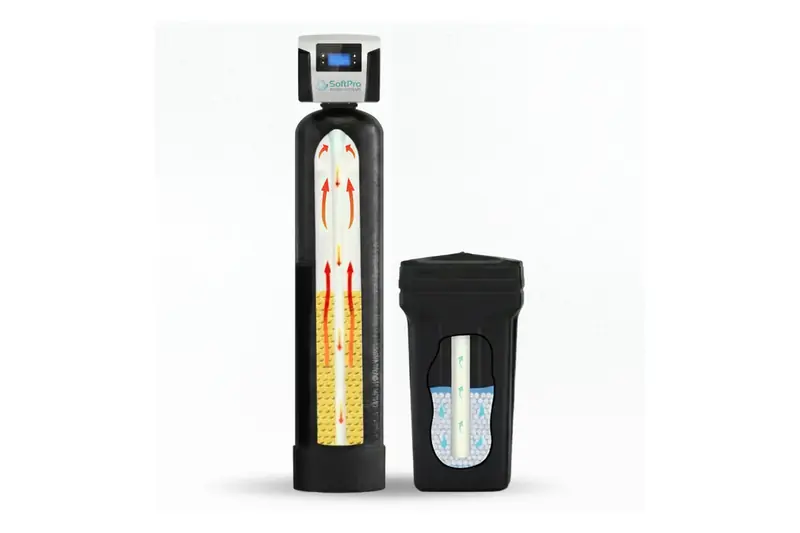
Best for larger city homes
SoftPro Elite Smart HE (city)
- Capacity: 32k, 40k, 48k or 64k grains, upflow regeneration
- Price (Oct 2026): from $1,367; Gold package from $2,447
- Coverage: lifetime limited on the valve and essential components
- Why it ranks here: more valve features and longer valve coverage than the ECO, at a higher price most city homes can skip
View at SoftProSold by a store run by the same team as this site. How we rank
The rest of the city water list
SpringWell's Salt Based Water Softener System suits big city homes that need flow. SpringWell lists 11 gpm on the SS1 (32,000 grains, 1 to 3 bathrooms), 13 gpm on the SS4 (48,000, 4 to 6) and 20 gpm on the SS+ (80,000, 7+), with 1-inch connections and a 25 to 80 psi range. No carbon stage comes with it, so chlorinated homes need a separate filter ahead of it. Its warranty tab lists lifetime cover on items such as tanks and valves, with shorter terms on electronic heads.
Best for high-flow homes
SpringWell SS
- Flow: up to 20 gpm on the SS+, per SpringWell
- Capacity: 32k, 48k or 80k grains
- Price (Oct 2026): from $1,606.50
- Why it ranks here: excellent published flow figures, but the carbon stage is a separate purchase
Sold by its maker; we do not link to other brands.
Aquasana's Rhino with the Salt-Free Water Conditioner add-on is the one setup here that does not soften. Rhino is a whole-house carbon filter rated for 1,000,000 gallons or 10 years, and Aquasana says it was tested to NSF/ANSI Standard 42 for up to 97% chlorine removal. The conditioner limits scale without salt or a drain, but the water stays hard, and Aquasana says it works best below 15 gpg. The strength is one vendor and one 10-year limited warranty for both jobs.
Best no-salt combo
Aquasana Rhino + Salt-Free Conditioner
- Filter life: 1,000,000 gallons or 10 years, per Aquasana
- Price (Oct 2026): $1,998 plus $1,548 for the conditioner
- Limits: conditioner best below 15 gpg hardness
- Why it ranks here: good chlorine filtration with salt-free scale control, but hardness is not removed
Sold by its maker; we do not link to other brands.
Does city water need a softener at all?
Only if the utility's annual report shows hard water. The EPA WaterSense softener guide draws the hard-water line at 7 gpg (120 mg/L) and names 10 gpg (180 mg/L) as the level where softening is commonly advised.
Reports usually give hardness in mg/L. Nebraska Extension's hardness table uses about 17.1 mg/L per gpg, so a report reading of 205 mg/L is roughly 12 gpg, in the very hard class above 10.5 gpg. The same report names the disinfectant your utility uses.
| Class | mg/L | gpg | Softener? |
|---|---|---|---|
| Soft | 0–17.1 | 0–1 | No |
| Slightly hard | 17.1–60 | 1–3.5 | Rarely |
| Moderately hard | 60–120 | 3.5–7 | Optional |
| Hard | 120–180 | 7–10.5 | Often worth it |
| Very hard | over 180 | over 10.5 | Usually recommended |
Why put a carbon filter before a city water softener?
Because the resin should meet water with the disinfectant already taken out. The A. O. Smith softener manual lists a maximum chlorine level of 0 ppm in its softener specifications, and the EPA guide says a softener goes on the line after any whole-house filter.
City water can legally carry a fair amount of disinfectant. The EPA's drinking water regulations set a maximum residual of 4.0 mg/L for both chlorine and chloramines. The EPA's chloramine page says chloramines form when ammonia is added to chlorine, last longer in the pipes, and reach more than one in five Americans. If your report names chloramine, buy a carbon stage whose maker says it handles chloramine, as SoftPro states for Gold.
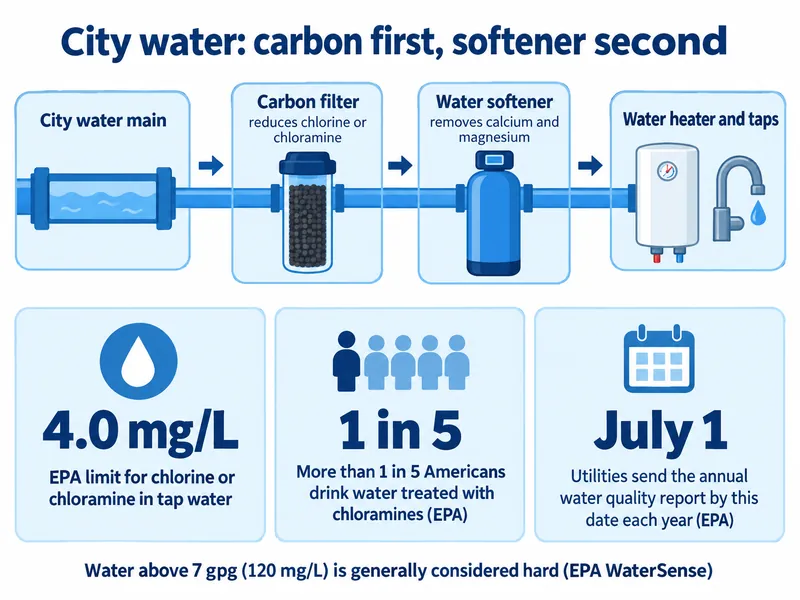
City water numbers worth knowing
- 4.0 mg/LHighest chlorine or chloramine level allowed in tap waterU.S. EPA
- 1 in 5Americans who drink water treated with chloramines (more than)U.S. EPA
- July 1Annual deadline for utilities to deliver the water quality reportU.S. EPA
- 0 ppmMaximum chlorine listed in one maker's softener specificationsA. O. Smith softener manual
What size softener does a city home need?
Daily load is people × 75 gallons × hardness in gpg, using the per-person figure from Penn State Extension's softening guide. Four people on 12 gpg city water remove 3,600 grains a day, about 25,200 a week, so a 32,000-grain ECO or Elite covers them with room to spare at an efficient salt setting.
A couple on 10 gpg needs about 1,500 grains a day, so even the smallest size runs well over a week between cycles. The EPA warns that oversizing wastes water, so resist buying the largest tank by default. Our sizing guide has more worked examples, and salt vs potassium chloride covers households limiting sodium.
Related guides

How we put this page together
Specs and prices on this page come from SoftPro, SpringWell and Aquasana product pages as they read in October 2026. Disinfectant, hardness and sizing figures come from EPA pages (drinking water regulations, chloramines, Consumer Confidence Reports, WaterSense), Nebraska and Penn State Extension, and A. O. Smith's published softener manual. No samples were run by us, and an older claim about resin life on chlorinated water was cut because no primary source backed it.
Common questions
Where is the hardness of city water published?
In your utility's Consumer Confidence Report, which the EPA requires community water systems to deliver each year by July 1. If hardness is listed in mg/L, divide by about 17.1 for gpg.
How can you tell if a city uses chloramine instead of chlorine?
The same annual report usually names the disinfectant. The EPA says chloramines are made by adding ammonia to chlorine and that more than one in five Americans drink chloraminated water.
What is the difference between SoftPro's Gold and Gold+ packages?
Gold adds the Chlorine+ catalytic carbon filter for chlorine and chloramine. Gold+ adds a SUPER Filter with catalytic carbon plus bone char for fluoride. Both are filter stages; the softener itself removes hardness.
Does the carbon filter go before or after the softener?
Before. The EPA's WaterSense guide places the softener after any whole-house filter, so the resin sees dechlorinated water and every tap gets filtered water.
Will softened city water taste salty?
Not usually, but it carries more sodium. Nebraska Extension puts the increase at about 8 mg/L per gpg removed, so 12 gpg water gains roughly 96 mg/L. A separate unsoftened cold tap for drinking avoids it.
Is a salt-free conditioner enough on city water?
It can limit scale on fixtures and heaters, but it does not remove hardness, so you will not get the slick feel or fewer soap spots. Aquasana, for one, says its conditioner works best below 15 gpg.
Can a city softener go outside or in the garage?
Placement depends on the maker's temperature range, and the EPA suggests installing after the line that feeds outdoor taps so irrigation water is not softened. Our installation guide covers placement.
Our pick
SoftPro ECO (city)
Check current sizes and prices at SoftPro.
View at SoftProwatersofteners.reviews is run by the same team as SoftPro Water Systems and Quality Water Treatment, and we rank their products first. How we rank
Comparing options? Start with our water softener reviews.