
Compare
Salt-Based vs Salt-Free Water Softeners
Salt-based vs salt-free water softeners: a salt-based unit removes calcium and magnesium so water tests soft, while a salt-free conditioner leaves the hardness in and only makes it less likely to form scale.
By the Water Softener Reviews editors · Updated
Disclosure: watersofteners.reviews is run by the same team as SoftPro Water Systems and Quality Water Treatment, and we rank their products first. We compare published specifications, certifications, warranties and prices (as of October 2026). We did not lab-test these units. How we rank
On this page
- Salt-based vs salt-free: what is the real difference?
- Do salt-free water softeners remove hardness?
- How do salt-based and salt-free systems compare side by side?
- Which handles very hard water, wells and iron?
- What does each cost to run and maintain?
- How do salt-based vs salt-free prices and warranties compare?
- Which should you choose?
- Common questions
Key takeaways
- Nebraska Extension classes no-salt units as descalant devices, not hardness removers, because the calcium and magnesium stay in the water (NebGuide G2275).
- The EPA says salt-free conditioners condition hardness ions instead of removing them and points buyers to the IAPMO/ANSI Z601 scale-reduction standard (EPA WaterSense guide).
- A salt-based softener adds about 8 mg/L of sodium per gpg removed, about 80 mg/L at 10 gpg (Nebraska Extension G1491).
- Softeners may also remove 5 to 10 ppm of iron and manganese; salt-free units are generally not designed for either.
- As of October 2026 the SoftPro Elite Smart HE for city water starts from $1,367 and the SoftPro FORTRESS conditioner from $229.
- SoftPro states the FORTRESS gives up to 99.6% scale prevention and says plainly that it does not reduce water hardness.
Salt-based vs salt-free: what is the real difference?
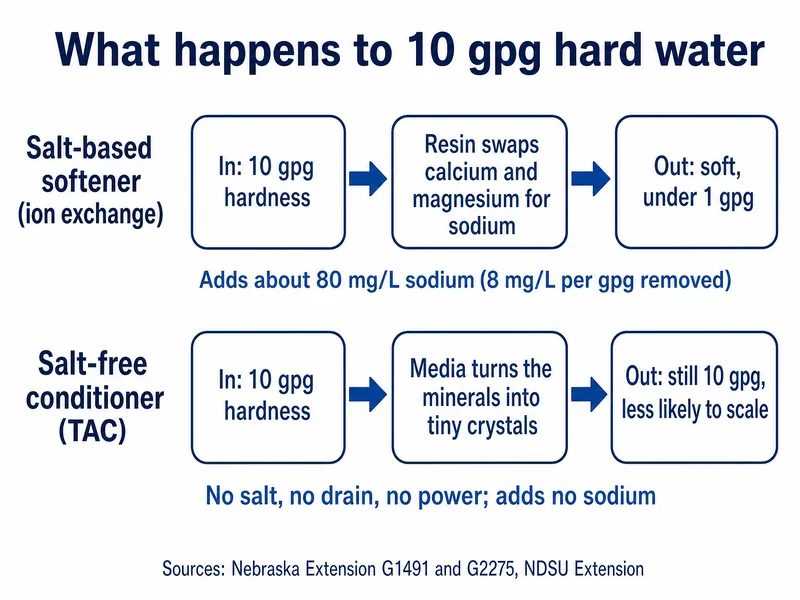
The difference is removal. A salt-based softener pulls calcium and magnesium out of the water and replaces them with sodium or potassium, so a hardness test reads soft afterward. A salt-free conditioner leaves those minerals in the water and changes their form so they are less likely to stick to pipes and heating elements.
That is why water-quality specialists avoid calling salt-free units softeners. Hardness is the dissolved calcium and magnesium the USGS describes, and when it is heated in a water heater it can drop calcium carbonate scale. A softener stops that at the source; a conditioner tries to keep the minerals from settling.
What the sources say
- 1 gpgtop of the "soft" class a softener brings water intoNebraska Extension G2275
- 8 mg/Lsodium added per gpg removed by a salt-based softenerNebraska Extension G1491
- 10 gpghardness above which softeners are often recommendedEPA WaterSense
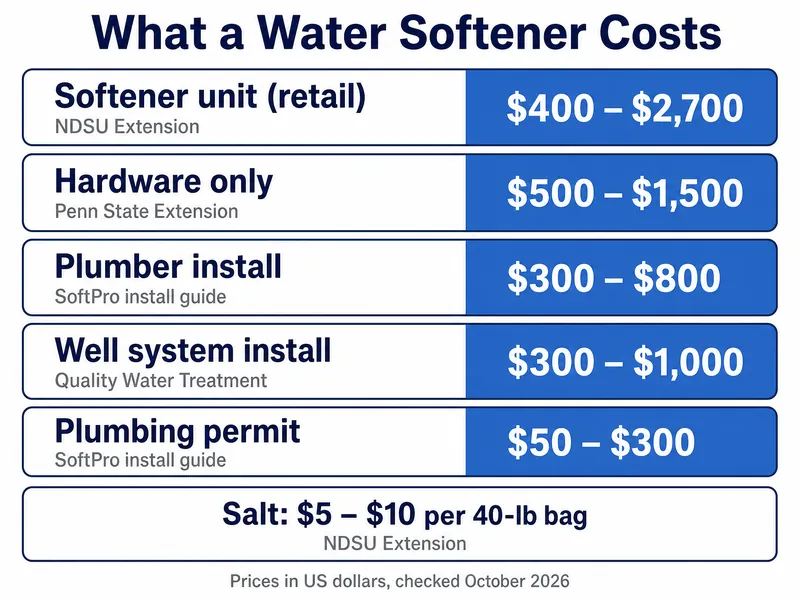
- $5–$10per 40 lb bag of sodium chloride saltNDSU Extension
- 75 gpghardness limit SoftPro lists for the FORTRESSSoftPro (a store run by our team)
Do salt-free water softeners remove hardness?
No. Nebraska Extension's December 2025 NebGuide says these devices leave the hardness in place and change its form to limit scale. Template-assisted crystallization (TAC), the media most whole-house conditioners use, converts dissolved calcium and magnesium into tiny insoluble crystals that pass through without coating surfaces. The minerals are still there, so a test strip reads the same before and after.
The EPA puts it the same way: instead of removing the hardness ions, conditioners condition them. Makers say so too. SoftPro's FORTRESS page admits it leaves hardness where a salt-based unit would cut it, and SpringWell's FutureSoft page says it won't make water feel slick or stop spotting the way salt does.
How well conditioners prevent scale in homes is less settled. Nebraska notes that few conclusive studies confirm residential performance. The EPA now suggests choosing a model that meets IAPMO/ANSI Z601, the standard for scale reduction devices.
How do salt-based and salt-free systems compare side by side?
The two do different jobs, so the table compares results first and equipment second.
| Factor | Salt-based softener | Salt-free conditioner (TAC) |
|---|---|---|
| Removes calcium and magnesium | Yes, nearly all | No, converts them to crystals |
| Hardness test afterward | Soft range (0–1 gpg) | Unchanged |
| Spotting and slick feel | Ended, per SpringWell's comparison | No change, per SpringWell |
| Scale on heaters and fixtures | Hardness removed at the source | Reduced, per maker claims |
| Iron and manganese | 5–10 ppm, per maker rating | Generally not designed for it |
| Salt, drain, electricity | Needs all three | None |
| Sodium added | About 8 mg/L per gpg removed | None |
| Standard to look for | NSF/ANSI 44 | IAPMO/ANSI Z601 |
Which handles very hard water, wells and iron?
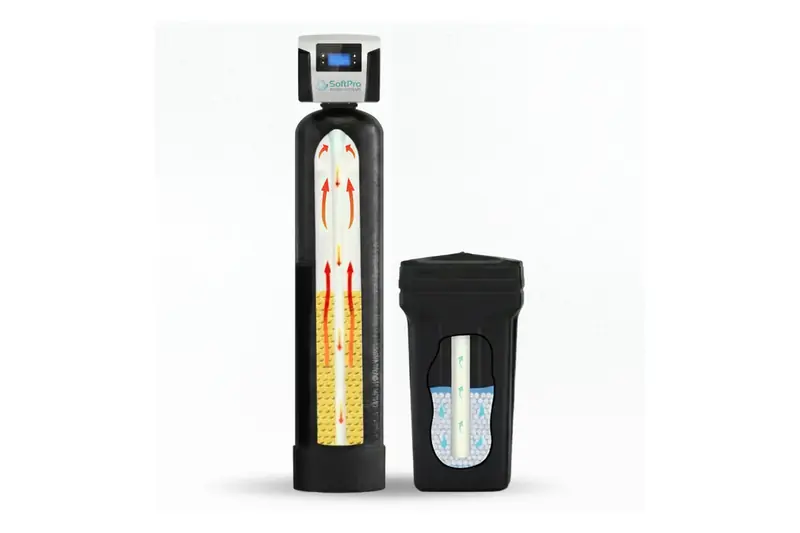
The salt-based route. The EPA says softeners are often recommended once hardness passes 180 mg/L or 10 gpg, and a softener's capacity is set in grains so it can be sized to any hardness. Our sizing guide has the math. The SoftPro Elite Smart HE for city water comes in 32,000 to 64,000 grains with 10% crosslink resin and an upflow, metered valve.
Conditioners are sized by flow and by the water chemistry the maker accepts. The SoftPro FORTRESS lists service flow up to 6 gpm (Home), 10 gpm (Pro) and 16 gpm (Commercial), a 75-grain hardness limit, 40 to 100 °F and up to 90 psi. Other makers draw tighter lines: Aquasana's salt-free conditioner is best suited to water below 15 gpg with iron under 0.3 ppm, and SpringWell's FutureSoft limits table allows no iron at all.
Iron settles it for wells. Nebraska Extension says softeners may remove as much as 5 to 10 ppm of iron and manganese, while no-salt options are, as a rule, not built for either and need pretreatment. See best softeners for well water for systems that handle both.
What does each cost to run and maintain?
Salt-based. Salt is the main ongoing cost. By SoftPro's estimate a typical Elite home empties one 40 lb bag in 2 to 4 months. With NDSU Extension's $5 to $10 bag price, that is about $15 to $60 of salt yearly. Each regeneration also sends water to the drain: Nebraska puts it near 50 gallons, and the EPA gives 20 to 70 gallons for a typical unit. SoftPro states the city Elite regenerates about every 14 days and uses up to 30% less salt through precision brining. Our salt vs potassium guide covers the regenerant choice.
Salt-free. No salt, no drain line and no electricity. The media wears out on the maker's schedule; SoftPro's FORTRESS spec table lists replacement every 2 years for the Home model and up to 5 years for the Pro and Commercial. Replacement media prices are not published on the product page. SoftPro's FORTRESS warranty excludes water with over 2.0 ppm chlorine unless it is pretreated; your utility's report shows the level.
How do salt-based vs salt-free prices and warranties compare?
The conditioner is cheaper up front, the softener carries longer coverage. As of October 2026:
| Item | SoftPro Elite Smart HE (city) | SoftPro FORTRESS |
|---|---|---|
| Type | Salt-based softener | Salt-free conditioner (TAC) |
| Price (Oct 2026) | from $1,367 | from $229 (Home), $529 (Pro), $1,259 (Commercial) |
| Sizes | 32,000–64,000 grains | 6, 10 or 16 gpm |
| Warranty | Limited lifetime (valve and essential components) | 1-year limited |
| Certification wording | NSF, WQA and ANSI listed; standard not named | IAPMO R&T, to the NSF/ANSI/CAN 61 materials standard |
| Install | DIY in 2 to 3 hours; drain and outlet needed | No drain or power; SoftPro recommends a pro install |
NSF/ANSI/CAN 61 covers whether materials are safe in contact with drinking water; it says nothing about how well the FORTRESS prevents scale, and SoftPro's page does not name Z601. For the Elite, SoftPro lists NSF, WQA and ANSI certification on the product page without naming the standard.
Which should you choose?
Pick by situation
Hard or very hard water
Above about 10 gpg, choose a salt-based softener. The SoftPro Elite for city water (sold by SoftPro, a store run by our team) starts from $1,367 as of October 2026.
Well water
Use a salt-based softener sized for any iron, with a dedicated iron filter if needed.
Moderately hard city water, no drain
A conditioner fits. The SoftPro FORTRESS (sold by SoftPro, a store run by our team) starts from $229 as of October 2026.
Sodium limits or softener rules
The EPA notes salt-free units suit some medical conditions and places where softeners are prohibited. Potassium chloride in a softener is the other route.
For more detail read our SoftPro Elite review and SoftPro FORTRESS review, or compare other options in best salt-free softeners.
Related guides
Common questions
Do salt-free water softeners really work?
They are designed to reduce scale, not to soften. Nebraska Extension says few conclusive studies confirm how well they work in homes, and water still tests hard afterward. If you want one, the EPA suggests a model that meets IAPMO/ANSI Z601.
Will a salt-free system stop spots on glasses?
Usually not. SpringWell concedes its own conditioner leaves spotting that salt would fix, and Nebraska notes a fine dust can form on dishes with TAC. Only removing the hardness ends spotting.
Can a salt-free system handle well water?
Not without pretreatment in most cases. Nebraska says no-salt units are, as a rule, not built for iron or manganese, and SoftPro sells the FORTRESS for city water.
How much sodium does a salt-based softener add?
About 8 mg/L for every gpg removed, so 10 gpg water ends near 80 mg/L. Our soft water drinking guide covers potassium and bypass-tap options.
Does a salt-free conditioner remove existing scale?
Do not count on it. SoftPro states the FORTRESS prevents new scale but does not remove buildup already in pipes or appliances.
Is it possible to switch from salt-free to salt-based later?
Yes. Both go on the main line where water enters the house. A softener also needs a drain and an outlet nearby, so plan for them if an upgrade is likely.
Which one uses water?
Only the salt-based softener, during regeneration: about 50 gallons a cycle by Nebraska's figure, 20 to 70 by the EPA's. A TAC conditioner has no drain line or backwash.
How we put this page together
This page is based on Nebraska Extension NebGuides G2275 (Dec 2025) and G1491, the EPA WaterSense softener guide (May 2026), NDSU Extension WQ1031, the USGS hardness page, and the makers' own product pages for the SoftPro Elite, SoftPro FORTRESS, SpringWell FutureSoft and Aquasana Salt-Free Water Conditioner, all checked in October 2026. Not covered: magnetic and electronic descalers, scale-prevention percentages beyond the maker's own claim, review counts, owner forums, and lab work, which we did not do.
Our pick
SoftPro Elite Smart HE (city)
Check current sizes and prices at SoftPro.
View at SoftProwatersofteners.reviews is run by the same team as SoftPro Water Systems and Quality Water Treatment, and we rank their products first. How we rank
Comparing options? Start with our water softener buying guide.