
Best picks
Best Water Softeners for Well Water
The best water softener for well water in 2026 is the SoftPro Elite Smart HE well build, from $1,327 alone or $2,827 with an iron filter (October 2026), matched to a lab test first.
By the Water Softener Reviews editors · Updated
Disclosure: watersofteners.reviews is owned by the team behind SoftPro Water Systems and Quality Water Treatment, and we rank their products first. We compare published specifications, certifications, warranties and prices (as of October 2026). We did not lab-test these units. How we rank
On this page
- Which is the best water softener for well water?
- How did we rank well water softeners?
- #1 SoftPro Elite Smart HE (well)
- #2 Fleck 2510SXT (QWT)
- The rest of the well water list
- What should a well water test include?
- How do iron and sulfur change the softener you need?
- What size water softener does a well need?
- Common questions
Key takeaways
- SoftPro Elite Smart HE (well) takes the top spot in four sizes from $1,327, or $2,827 with an AIO Iron Master that SoftPro rates to 30 ppm iron (Oct 2026).
- The Fleck 2510SXT from Quality Water Treatment ranks second, with fine mesh resin that QWT rates for 3 ppm clear-water iron and 1 ppm manganese.
- The EPA tells well owners to test every year for coliform bacteria, nitrate, total dissolved solids and pH.
- EPA secondary standards put iron at 0.3 mg/L and manganese at 0.05 mg/L, the levels where staining and metallic taste begin.
- Penn State Extension recommends a softener alone only above pH 6.7, at 3 to 20 gpg hardness and under 5 mg/L dissolved iron.
- A. O. Smith's softener manual adds 5 gpg to the hardness setting for every 1 ppm of ferrous iron, which can push a well up a size.
Which is the best water softener for well water?
For most private wells it is the SoftPro Elite Smart HE in its well build, followed by the Fleck 2510SXT and the SoftPro ECO well model. Well water arrives untreated, so hardness often comes with dissolved iron, manganese, low pH or a sulfur smell, and we ranked each system partly on the filter stages its seller pairs with it.
| Rank | Product | Best for | Capacity (grains) | Oct 2026 price |
|---|---|---|---|---|
| #1 | SoftPro Elite Smart HE (well) | Hard well water, with or without iron | 32,000–64,000 | $1,327 |
| #2 | Fleck 2510SXT (QWT) | Clear-water iron, acidic water options | 24,000–64,000 | softener from $1,494.04 |
| #3 | SoftPro ECO (well) | Lower-cost well softening | 32,000–64,000 | $947 |
| #4 | SpringWell WSSS well combo | One-order filter plus softener | 32,000–80,000 (softener) | $3,123.75 |
| #5 | US Water Systems Matrixx | Wells with no iron issue | 35,000–70,000 | $1,295.95 |
How did we rank well water softeners?
Each system was judged on its seller's published iron, manganese and sulfur limits (and which stage they belong to), iron-ready resin, filter packages sized by pump flow, and warranty wording. A missing figure stays "not published".
Iron limits carried the most weight, since Penn State warns that oxidized iron fouls resin. For heavy iron or sulfur on its own, see our iron and sulfur roundup.
#1 SoftPro Elite Smart HE (well)
SoftPro builds the well Elite around a downflow control valve whose programming, in its words, is optimized for variable well water, with 1-inch internal plumbing. It is metered, with vacation mode, auto reserve and 48-hour capacitor backup. The resin is 10% crosslink, and SoftPro mentions an optional fine mesh upgrade for higher ferrous iron.
The bundle is what puts it first. The softener-only option is labeled "hardness only (no iron or odor issues)". For wells that do carry iron or odor, SoftPro adds the AIO Iron Master, a Katalox Light catalytic filter it rates at 30 ppm iron and 7 ppm manganese that also treats hydrogen sulfide. You choose it by pump flow (6 to 7, 8 to 10 or 11+ gpm); with the 32,000-grain softener it lists at $2,827, $3,066 and $3,220 as of October 2026.
SoftPro expects regeneration about every 4 to 7 days and states that precision brining saves up to 30% more salt. SoftPro covers the valve and essential components for life (limited) and offers a 6-month money-back guarantee. Setup are in our SoftPro Elite review.
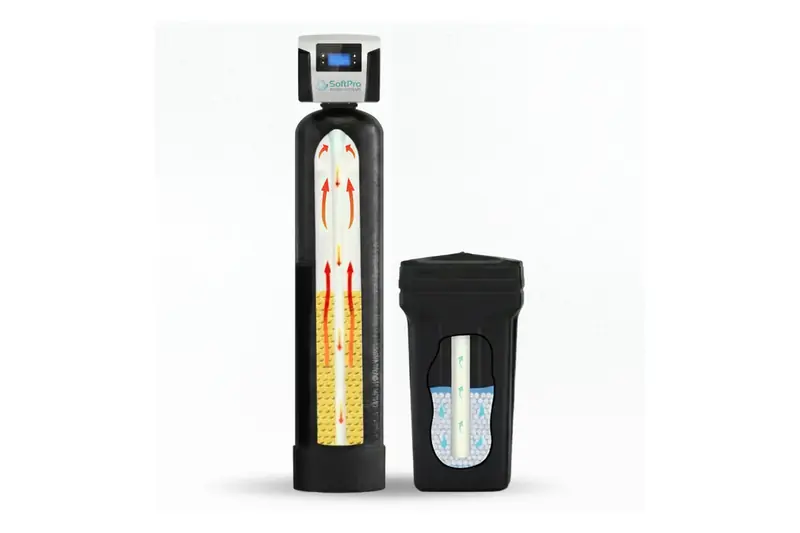
Best for most wells
SoftPro Elite Smart HE (well)
- Grain sizes: four, 32k to 64k
- Price (Oct 2026): from $1,327 softener only; from $2,827 with AIO Iron Master
- Iron Master stage: SoftPro rates it at 30 ppm iron, 7 ppm manganese, and treats sulfur odor
- Why it ranks here: a well-specific downflow valve with an iron filter sized to your pump, sold as one package
View at SoftProSold by a store we own. How we rank
#2 Fleck 2510SXT (QWT)
Quality Water Treatment's 2510SXT is the most configurable well package here. The base unit pairs fine mesh resin with a digital metered Fleck valve, and peak flow rises with size from 7 gpm (24k) to 16 gpm (64k). QWT rates the softener alone for 3 ppm clear-water iron and 1 ppm manganese.
Stages bolt on from there. A KDF 85 option targets up to 2 ppm sulfur; a calcite neutralizer handles acidic water between pH 6.0 and 6.9, and its backwash valve is the only part on the page called NSF-certified. The AIO iron filter package is rated by QWT to 30 ppm iron, 7 ppm manganese and 5 ppm hydrogen sulfide.
As of October 2026 the softener alone starts at $1,494.04 and one softener-plus-pH package lists at $1,218.62, so price the exact configuration you need. Coverage is 5 years on the valve and 10 on the mineral and brine tanks, and QWT's own review notes the valve lacks vacation mode, auto refresh and auto backwash. Store background is in our Quality Water Treatment review.
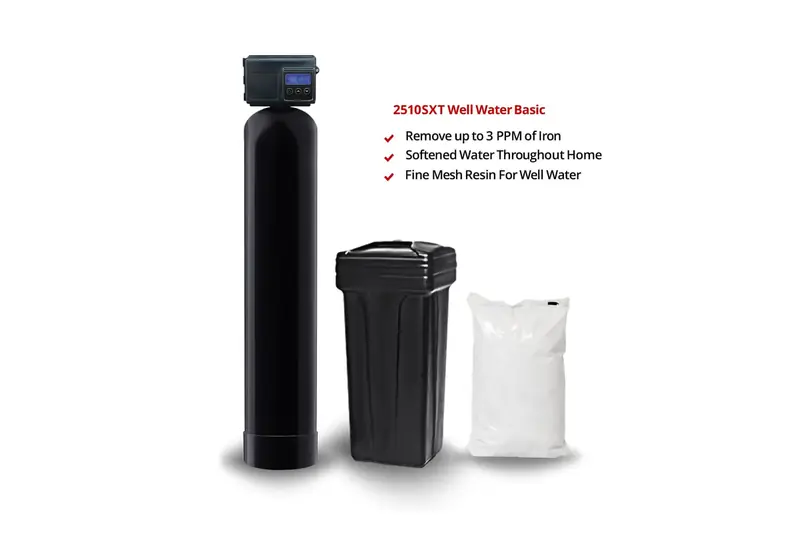
Most configurable well package
Fleck 2510SXT (QWT)
- Grain sizes: 24k to 64k, peak flow 7 to 16 gpm by size
- Price (Oct 2026): softener from $1,494.04; packages from $1,218.62
- Softener by itself: rated by QWT for 3 ppm clear iron, 1 ppm manganese
- Why it ranks here: published limits for every stage, plus KDF and pH neutralizer options no other pick here lists
View at Quality Water TreatmentSold by a store we own. How we rank
The rest of the well water list
SoftPro's ECO well model is the budget route into SoftPro's well line: fine mesh resin that SoftPro says captures dissolved iron better than standard resin, a metered valve and a pre-installed bypass. It comes in 32k, 48k or 64k grains from $947 as of October 2026, or from $2,191.94 with the Pro Iron Filter. SoftPro says the filter package is required, not optional, once iron passes 0.3 ppm, the same figure as the EPA's iron guideline. It carries a "Lifetime Limited Warranty", and SoftPro states up to 10% salt savings against older systems.
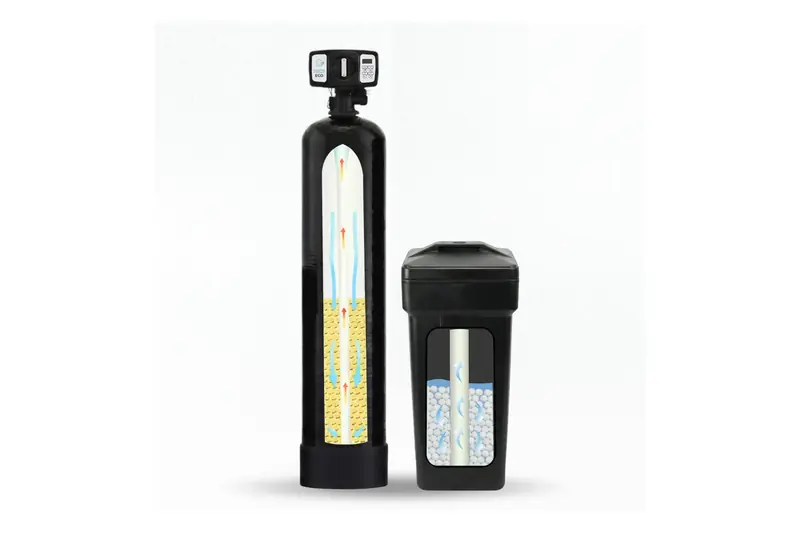
Best value for wells
SoftPro ECO (well)
- Grain sizes: 32k, 48k or 64k
- Price (Oct 2026): from $947; from $2,191.94 with the Pro Iron Filter
- Resin: fine mesh, aimed at dissolved iron
- Why it ranks here: the lowest well-ready price here, with a clear 0.3 ppm iron threshold for adding the filter
View at SoftProSold by a store we own. How we rank
SpringWell's WSSS combo pairs an iron filter (WS1 at 12 gpm or WS4 at 20 gpm) with its SS softener in 32k, 48k or 80k sizes. Its genuine strength: a lab water test is a required add-on, and SpringWell holds well orders until results are back.
Best one-order combo
SpringWell WSSS well combo
- Packages: WSSS1 and WSSS4
- Price (Oct 2026): from $3,123.75
- Iron filter: rated to 7 ppm iron and 8 ppm hydrogen sulfide on SpringWell's filter page
- Why it ranks here: a required water test before shipping, at a higher entry price than our owned bundles
Sold by its maker; we do not link to other brands.
The US Water Systems Matrixx suits a well with hard but iron-free water. Service flow is 10, 15 or 20 gpm, and tank and resin are covered for life, valve and electronics for 10 years. No iron rating appears on the product page; the maker's FAQ suggests an iron filter ahead of any softener.
Iron-free wells
US Water Systems Matrixx
- Grain sizes: 35k, 53k or 70k maximum
- Price (Oct 2026): from $1,295.95
- Service flow: 10, 15 or 20 gpm
- Why it ranks here: strong warranty and data, but no published iron rating for well use
Sold by its maker; we do not link to other brands.
What should a well water test include?
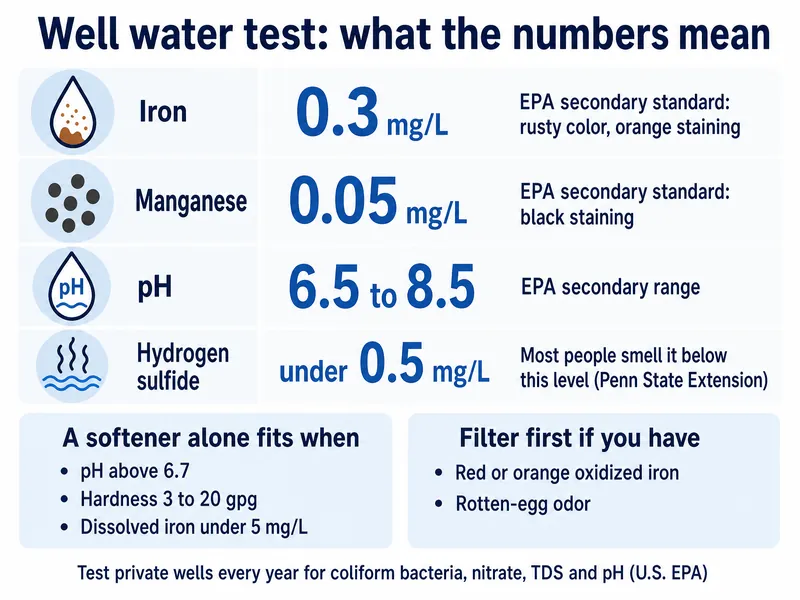
Test hardness, iron, manganese, pH and hydrogen sulfide before you buy, plus the yearly checks the EPA lists for private wells: coliform bacteria, nitrate, total dissolved solids and pH. The EPA notes some local health departments test private wells for free.
| Result | Guide figure | Source | What it means for the system |
|---|---|---|---|
| Iron | 0.3 mg/L | EPA secondary standard | Above it, expect orange staining; SoftPro wants a filter on the ECO here |
| Manganese | 0.05 mg/L | EPA secondary standard | Black staining; check each filter's manganese limit |
| pH | 6.5–8.5 | EPA secondary standard | Below 6.7, Penn State advises against a softener alone |
| Dissolved iron | under 5 mg/L | Penn State Extension | Ceiling for treating iron with a softener alone |
| Hydrogen sulfide | below 0.5 mg/L | Penn State Extension | Most people can already smell it at this level |
The EPA's secondary standards are taste, color and staining guides, not health limits.
How do iron and sulfur change the softener you need?
Dissolved, clear-water iron within the maker's limit can go through the softener; red iron and rotten-egg odor need a filter ahead of it. Penn State says oxidized iron fouls resin and that raw water should not meet air or chlorine before the softener. NDSU Extension says some softeners remove up to 10 ppm of iron and manganese, but the maker's figure rules: 3 ppm on the 2510SXT softener alone.
For sulfur, the Penn State hydrogen sulfide guide says activated carbon may handle less than about 1.0 mg/L, catalytic carbon handles more, and chlorination or oxidizing filters suit levels above 6.0 mg/L.
The EPA WaterSense softener guide also says a softener belongs after any whole-house filter, so the filter catches iron and sediment first. Our installation guide covers drain, bypass and loop.
Well water numbers worth knowing
- 0.3 mg/LIron guide level for staining and metallic tasteU.S. EPA
- 0.05 mg/LManganese guide level for black stainingU.S. EPA
- 5 mg/LMost dissolved iron a softener alone should facePenn State Extension
- 5 gpgAdded to the hardness setting per 1 ppm of ferrous ironA. O. Smith softener manual
What size water softener does a well need?
Size a well softener on compensated hardness, not hardness alone. The A. O. Smith manual adds 5 gpg for every 1 ppm of ferrous iron, so 18 gpg water with 2 ppm iron is treated as 28 gpg.
Using Penn State's planning figure of 75 gallons per person a day, four people on 28 gpg remove 8,400 grains a day, or 58,800 a week. That sits just under the Elite's 64,000-grain top size, which is rated at maximum salt, so expect regeneration more often than weekly at an efficient setting. The WQA's softener guidance also warns of hardness leakage at high-efficiency settings once iron passes 2 ppm or hardness passes 30 gpg. Our sizing guide has more worked examples.
Related guides
 Our brandsSoftPro ECO review
 Other brandsSpringWell review
 Other brandsUS Water Systems review
 CompareSoftPro vs SpringWell
How we put this page together
This ranking uses the sellers' and makers' own product pages, checked in October 2026, for every product spec and price. General figures come from primary sources: the EPA private-well, secondary-standards and WaterSense pages, Penn State and NDSU Extension, the WQA and the A. O. Smith softener manual. We did no lab work and left out forum anecdotes, dealer blogs, and older rules of thumb for manganese and resin life that we could not trace to a primary source.
Common questions
Can a well softener remove iron without a separate filter?
Only clear, dissolved iron within the maker's limit. QWT rates the 2510SXT softener at 3 ppm, and SoftPro requires the Pro Iron Filter with the ECO above 0.3 ppm. Penn State caps a softener-only setup at under 5 mg/L dissolved iron and pH above 6.7.
Where does the iron filter go on a well system?
Ahead of the softener, so the softener only sees filtered water. The EPA's WaterSense guide gives the same order for any whole-house filter. Both SoftPro and QWT size their iron packages by pump flow, so measure gallons per minute first.
Is low pH a problem for a well softener?
It can be. The EPA's guide range is 6.5 to 8.5, and Penn State suggests a softener alone only above pH 6.7. QWT's calcite neutralizer option is listed for pH 6.0 to 6.9.
Could a softener cause a rotten-egg smell?
Rarely, yes. Penn State notes a softener can give sulfur-reducing bacteria a place to grow. If the odor appears only in hot water, the water heater's magnesium rod is the more common cause.
Does a well softener work with a septic system?
Usually, but check first. The EPA says to ask the septic maker or a local service provider, and Nebraska Extension puts a typical regeneration at about 50 gallons of water sent to drain.
How often should a private well be tested?
The EPA says every year for coliform bacteria, nitrate, total dissolved solids and pH, and sooner after flooding or a change in taste, color or smell. Add iron, manganese and hardness before choosing a softener.
Our pick
SoftPro Elite Smart HE (well)
Check current sizes and prices at SoftPro.
View at SoftProwatersofteners.reviews is owned by the team behind SoftPro Water Systems and Quality Water Treatment, and we rank their products first. How we rank
Comparing options? Start with our water softener reviews.