
Compare
Water Softener vs Water Conditioner
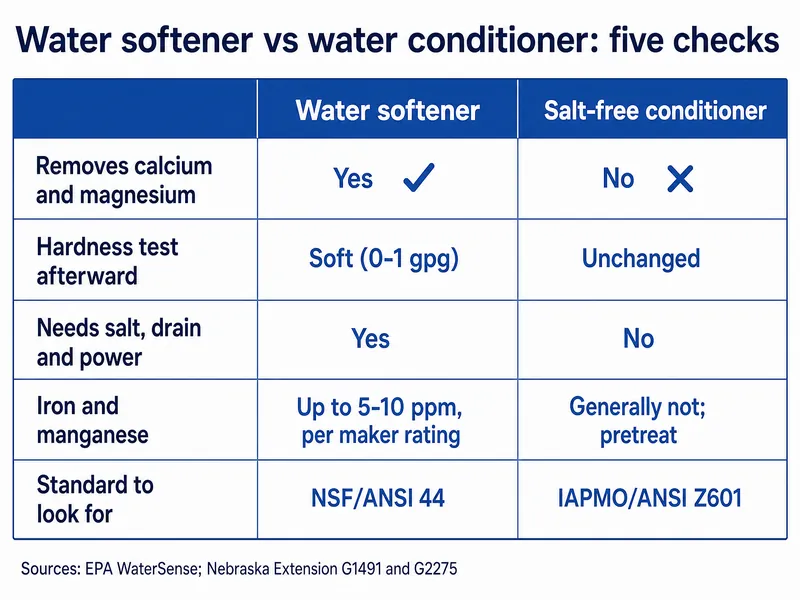
Water softener vs water conditioner: a softener removes calcium and magnesium by ion exchange, while a conditioner leaves them in and changes their form to cut scale, so only a softener makes water test soft.
By the Water Softener Reviews editors · Updated
Disclosure: watersofteners.reviews is run by the same team as SoftPro Water Systems and Quality Water Treatment, and we rank their products first. We compare published specifications, certifications, warranties and prices (as of October 2026). We did not lab-test these units. How we rank
On this page
- Water softener vs water conditioner: what does each one do?
- Does a water conditioner remove hardness?
- What counts as a water conditioner?
- How do a softener and a conditioner compare side by side?
- Which works better for your water supply?
- What does each one cost to own?
- Which should you choose?
- Common questions
Key takeaways
- Nebraska Extension says no-salt conditioning devices leave hardness in the water and only change its form, which is why it groups them as descalers (NebGuide G2275).
- The EPA describes conditioners as treating hardness ions rather than removing them, and names IAPMO/ANSI Z601 as the scale-reduction standard to look for (EPA WaterSense guide).
- Nebraska lists four no-salt technologies sold as conditioners and calls the magnetic kind unproven.
- An ion exchange softener can take out nearly all calcium and magnesium and adds about 8 mg/L of sodium per gpg removed (Nebraska Extension G1491).
- As of October 2026 the SoftPro ECO City softener starts from $967 and the SoftPro FORTRESS conditioner from $229.
- Aquasana's conditioner is best suited to water under 15 gpg with iron under 0.3 ppm, a typical published limit for the category.
Water softener vs water conditioner: what does each one do?
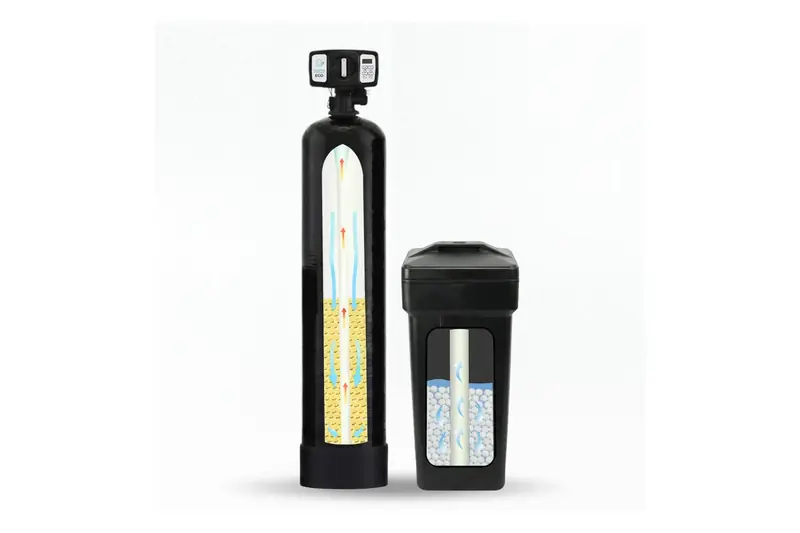
A water softener takes hardness out; a water conditioner leaves it in. The softener runs water over resin beads that hold sodium or potassium and trade it for calcium and magnesium, so the water leaving the tank tests in the soft range. A conditioner changes how those minerals behave, usually by turning them into tiny crystals, so less of them bonds to pipes, fixtures and water heater elements.
Both aim at the same nuisance. Hard water leaves scale on fixtures and water heaters, film on glassware and poor soap performance, according to Nebraska Extension, which also notes that hard water is not a health risk. The two systems simply attack it from opposite ends. For the softener side in detail, see how a water softener works.
What the sources say
- 4no-salt technologies sold to manage hardnessNebraska Extension G2275
- Z601IAPMO/ANSI standard for scale reduction devicesEPA WaterSense
- 8 mg/Lsodium a softener adds per gpg of hardness removedNDSU Extension
- 15 gpghardness ceiling Aquasana gives for its conditionerAquasana
- $967SoftPro ECO City softener, 32,000 grains, Oct 2026SoftPro (a store run by our team)
Does a water conditioner remove hardness?
No. Nebraska Extension's NebGuide G2275 states that these devices "do not remove the hardness" and instead change its form to limit scale, and the EPA's 2026 guide says conditioners treat the hardness ions instead of removing them. A hardness strip dipped in conditioned water reads about what it read before.
Sellers of conditioners say the same in their fine print. SoftPro's FORTRESS page says the unit leaves hardness in place, unlike a salt-based softener, and SpringWell's FutureSoft page warns that its conditioner won't bring the slick feel of softened water. What a conditioner promises is less new scale, which is a different result from soft water.
What counts as a water conditioner?
"Water conditioner" is a loose label. Nebraska Extension lists four no-salt technologies sold to deal with hardness, and they are not equally proven.
| Technology | How it works | What Nebraska says |
|---|---|---|
| Template-assisted crystallization (TAC) | Treated beads turn dissolved hardness into tiny insoluble crystals | Needs fairly clean water; may need pretreatment for iron, manganese or sediment |
| Electrically induced precipitation | Direct current drops hardness onto an electrode | The electrode must be cleaned from time to time |
| Electrochemical treatment | Electrodes plus ion exchange membranes pull ions out | Reaches under 5 gpg but struggles to get below 1 gpg |
| Magnetic treatment | Water passes through a magnetic field | Unproven, with no scientific consensus |
This page covers media conditioners, mainly TAC, which is what the major brands we review sell for whole-house use. Electrochemical units are the one type that does lower hardness, but Nebraska notes they rarely reach the soft range.
How do a softener and a conditioner compare side by side?
The quickest test is what you see at the tap.
| Item | Water softener | TAC conditioner |
|---|---|---|
| Calcium and magnesium | Taken out, nearly all | Left in, as crystals |
| Hardness reading | Soft | Same as before |
| Shower feel | Slick, easy lather | About the same as before |
| Spots on glass | Largely gone | Still likely; fine dust possible |
| Sodium | Adds about 8 mg/L per gpg | Adds none |
| Ongoing needs | Salt, drain water, power | Media changes only |
| Performance standard named by the EPA | NSF/ANSI 44 | IAPMO/ANSI Z601 |
Which works better for your water supply?
A softener works across the widest range of water. Its grain rating lets you match the tank to your hardness and family size; our sizing guide shows how. The SoftPro ECO City is offered at 32K, 48K and 64K grains with metered regeneration and 8% crosslink resin SoftPro expects to last as long as 20 years in normal service. SoftPro designed the ECO for 3/4-inch plumbing and points homes with 1-inch lines toward the Elite.
A conditioner works only inside the maker's chemistry window. SoftPro caps FORTRESS feed water at 75 grains of hardness, rates the three sizes for flows of 6, 10 and 16 gpm, and claims up to 99.6% scale prevention. Aquasana recommends its conditioner for water under 15 gpg, alkalinity under 250 mg/L, pH below 8.3 and iron under 0.3 ppm.
Wells usually point to a softener. Nebraska Extension says a softener may also remove 5 to 10 ppm of iron and manganese, while TAC units may need pretreatment for both. Our best softeners for city water list covers treated municipal supplies, where conditioners fit best.
What does each one cost to own?
Softener. Salt is the recurring cost, roughly $5 to $10 for each 40 lb bag of sodium chloride, according to NDSU Extension. SoftPro states the ECO uses 10% less salt than traditional systems. Each regeneration also uses water; the EPA's figure for a typical unit is 20 to 70 gallons. If sodium matters to you, see salt vs potassium chloride.
Conditioner. No salt, drain water or power. SoftPro's schedule calls for fresh FORTRESS media at two years on the small cartridge model and as long as five on the two tank models; it does not list a refill price. Keep chlorine in mind too, since SoftPro's warranty terms exclude water over 2.0 ppm that has not been pretreated.
| Item | SoftPro ECO City | SoftPro FORTRESS |
|---|---|---|
| Category | Ion exchange softener | TAC scale preventer |
| Price (Oct 2026) | $967 / $1,117 / $1,447 by size | $229 Home / $529 Pro / $1,259 Commercial |
| Capacity rating | 32K, 48K or 64K grains | Flow only: 6, 10 or 16 gpm |
| Warranty | Tanks: lifetime limited. Valve: 10 years | 1-year limited |
| Certification wording | Not published | IAPMO R&T, NSF/ANSI/CAN 61 (materials safety only) |
| Plumbing | 3/4-inch lines, bypass pre-installed; drain and outlet | Passive; professional fitting advised by SoftPro |
The FORTRESS Home is cheaper up front and covers about 1 to 2 baths. Over ten years the sticker matters less than the result: if spotting and soap use bother you, only the softener fixes them.
Which should you choose?
Match the system to the goal
You want soft water
Pick a softener. The SoftPro ECO City (sold by SoftPro, a store run by our team) starts from $967 as of October 2026; read our ECO review.
You only want less scale
For treated city water in the moderate range, a conditioner is a fair choice. The SoftPro FORTRESS (sold by SoftPro, a store run by our team) begins at $229 for the Home model (October 2026); our FORTRESS review covers the three sizes.
You are on a well
Choose a softener, with an iron filter ahead of it if needed.
No drain nearby
A conditioner avoids the drain line entirely, as long as your water sits inside its limits.
Compare more options in best salt-free softeners or weigh the trade-offs again in our salt-based vs salt-free comparison.
Related guides

Common questions
Is a water conditioner the same as a salt-free softener?
Yes, sellers use both names for the same products. "Salt-free softener" is a marketing term; the water is conditioned, not softened, and still tests hard.
How can you tell which one you have?
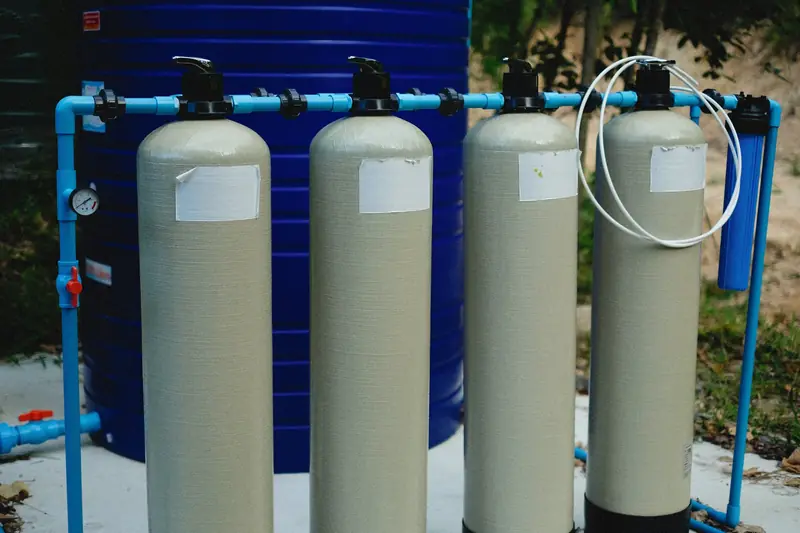
A softener has a brine tank, a drain line and a control valve with a display. A media conditioner is usually a single tank or cartridge with no drain or power. A hardness test on the outlet water settles it.
Do magnetic water conditioners work?
Nebraska Extension calls magnetic treatment unproven, with no scientific consensus on whether or how it works. We don't recommend buying one to manage hardness.
Is a conditioner the right choice for hard water on a well?
Rarely. TAC media needs fairly clean water and may need pretreatment for iron and manganese, and SoftPro markets the FORTRESS for municipal supplies only.
Which protects a water heater better?
A softener, because it takes the scale-forming minerals out entirely. A conditioner aims to keep them from bonding, and Nebraska notes few conclusive studies confirm how well that works in homes.
Does a softener make water salty?
Not to the taste at normal hardness. Sodium does climb, though: Nebraska's figure works out to about 80 mg/L once 10 gpg of hardness is exchanged.
Do conditioners need maintenance?
Yes, but only media swaps. The FORTRESS Home cartridge is due at two years, and SoftPro allows up to five on the larger Pro and Commercial tanks.
How we put this page together
Sources for this comparison: two University of Nebraska NebGuides (G2275 on no-salt options, G1491 on ion exchange), EPA WaterSense's 2026 buyer guide, NDSU's WQ1031 fact sheet, and maker pages for the ECO City, FORTRESS, FutureSoft and Aquasana conditioner, read in October 2026. Only media (TAC) conditioners are compared in detail. Excluded: brand claims for magnetic and electronic gadgets, review tallies, forum threads, and lab work, since we ran none.
Our pick
SoftPro ECO (city)
Check current sizes and prices at SoftPro.
View at SoftProwatersofteners.reviews is run by the same team as SoftPro Water Systems and Quality Water Treatment, and we rank their products first. How we rank
Comparing options? Start with our best water softeners and reviews.