
Best picks
Best RV Water Softeners
The best RV water softener for most campers in 2026 is the SoftPro portable from Quality Water Treatment, 8,000 or 16,000 grains from $267 as of October 2026; the On The Go OTG4 costs less.
By the Water Softener Reviews editors · Updated
Disclosure: watersofteners.reviews is run by the same team as SoftPro Water Systems and Quality Water Treatment, and we rank their products first. We compare published specifications, certifications, warranties and prices (as of October 2026). We did not lab-test these units. How we rank
On this page
- Which RV water softener is best in 2026?
- How did we choose the RV softeners?
- #1 SoftPro portable RV softener (QWT)
- #2 On The Go OTG4 portable
- Why are there only two RV water softener picks?
- How many gallons does an RV water softener deliver?
- How hard is campground water?
- How do you recharge and store a portable softener?
- Common questions
Key takeaways
- The SoftPro portable RV softener ranks first: 8,000 or 16,000 grains, $267 or $308 (Oct 2026), with a limited lifetime warranty on tank and valve.
- The On The Go OTG4 ranks second at $189.91 for 8,000 grains, listed by a large RV retailer; its warranty is not published.
- Gallons between recharges equal grain capacity divided by hardness: an 8,000-grain tank gives about 800 gallons on 10 gpg water and 400 on 20 gpg.
- The USGS found hard water prevalent in domestic wells across the east-central and western United States, so hardness changes from stop to stop.
- Softening adds about 8 mg/L of sodium for every gpg removed, according to Nebraska Extension.
- Both portables run without electricity and recharge with table salt in minutes.
Which RV water softener is best in 2026?
For most campers it is the SoftPro portable sold by Quality Water Treatment, with the On The Go OTG4 as the budget choice. Both are small resin tanks that sit on the hose between the campground spigot and the rig, soften until the resin is spent, then recharge with table salt.
| Model | Grains | Soft water per recharge (listed) | Size | Price |
|---|---|---|---|---|
| SoftPro portable 8,000 (QWT) | 8,000 | 800 gallons | 21.5 x 6 in | $267 |
| SoftPro portable 16,000 (QWT) | 16,000 | 1,680 gallons | 21.5 x 10 in | $308 |
| On The Go OTG4 Standard | 8,000 | Up to 20 days | 22 x 7-3/4 in, 18 lb | $189.91 |
| On The Go OTG4 Double Standard | 16,000 | 1,600 gallons, up to 40 days | 22 x 9-1/2 in, 34 lb | $234.80 |
How did we choose the RV softeners?
We compared the portable softeners whose seller or maker publishes current specs: grain capacity, gallons or days between recharges, recharge method, dimensions, warranty and price as of October 2026. The product from our team's store is listed first, and the competitor gets credit for every strength its listing states.
A portable has no control valve to compare, so warranty terms and how clearly the seller states capacity carried the most weight. Where a figure such as flow rate or resin type is missing from a listing, we say so rather than estimate it.
#1 SoftPro portable RV softener (QWT)
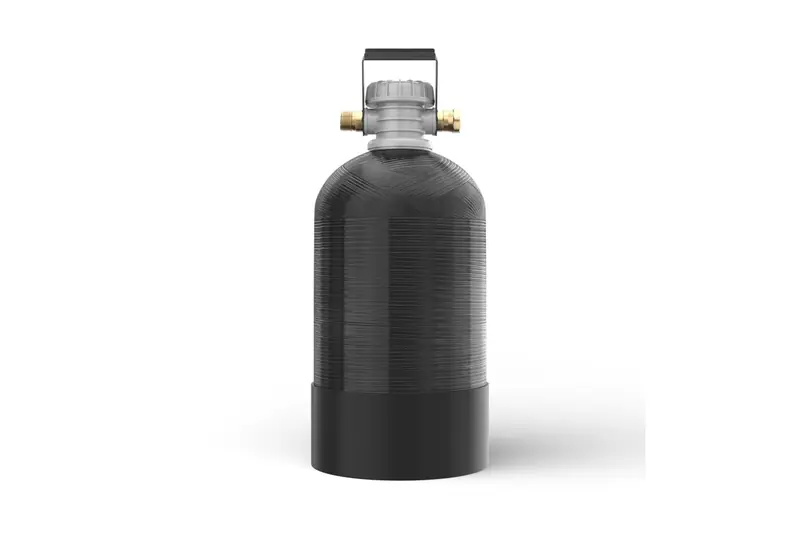
The SoftPro portable comes first for its warranty and its published gallons. QWT sells two sizes: 8,000 grains, labeled "1 person part time," at $267, and 16,000 grains, labeled "2 people part time," at $308, as of October 2026.
QWT's spec table lists 800 gallons of soft water between recharges for the 8,000 model and 1,680 for the 16,000. The tank needs no power and no drain. Recharging takes about 1 cup of table salt for the smaller tank and about 2 cups for the larger, and quick hose connections come in the box, with male and female adapters for hookup.
Both tanks stand 21.5 inches tall; the 8,000 is 6 inches wide and the 16,000 is 10. An optional spin-down sand separator is sold as an upgrade, useful on gritty well water. Coverage is a limited lifetime warranty on the tank and valve, plus QWT's 6-month money-back guarantee. Flow rate, resin type and certifications are not published. More on the seller in our Quality Water Treatment review.
Best RV softener overall
SoftPro portable RV softener (QWT)
- Capacity: 8,000 grains ("1 person part time") or 16,000 grains ("2 people part time")
- Listed soft water per recharge: 800 gallons (8,000) or 1,680 gallons (16,000)
- Price (Oct 2026): from $267; the 16,000-grain size is $308
- Warranty: limited lifetime on the tank and valve
- Why it ranks here: the strongest stated warranty in the category, with hose connections included
View at Quality Water TreatmentSold by a store run by the same team as this site. How we rank
#2 On The Go OTG4 portable
The OTG4 is the lower-cost route, listed by a large RV retailer at $189.91 for the 8,000-grain Standard (OTG4-CW-SS) and $234.80 for the 16,000-grain Double Standard (OTG4-CW-DS) as of October 2026. We could not find a maker website, so its facts come from that listing.
The listing says the Standard recharges with one box of table salt in under 15 minutes and gives soft water for up to 20 days. The Double Standard takes two boxes in under 30 minutes and is rated for 1,600 gallons, or up to 40 days. The Standard weighs 18 lb and the Double about 34.
Its strengths are price and simplicity: no tools or electricity, a standard hose hookup, and hardness test strips plus a back-flush adapter in the box. Flow rate is not published, though the listing says it is built for high flow with very low pressure drop. Warranty and certifications are not published, which is why it ranks second.
Best budget RV softener
On The Go OTG4 portable
- Models: Standard OTG4-CW-SS (8,000 grains) and Double Standard OTG4-CW-DS (16,000 grains)
- Recharge: one box of table salt in under 15 minutes (Standard); two boxes in under 30 (Double)
- Price (Oct 2026): from $189.91 (Standard); Double Standard $234.80
- Warranty and certifications: not published on the listing
- Why it ranks here: no tools or electricity needed, and the kit includes hardness test strips
Sold by its maker; we do not link to other brands.
Why are there only two RV water softener picks?
Because no other portable had current, first-party specs we could source in October 2026. We looked for a Watts RV model on the maker's catalog and found none, so it is left off rather than described from old data.
A full-time rig with room, power and a drain can carry a small cabinet softener instead; size it like a household unit with our water softener sizing guide. If the problem is rust stains or a rotten-egg smell rather than spots, a softener is the wrong tool; see our iron and sulfur picks. A salt-free conditioner does not remove hardness at all (salt-free conditioners explained).
How many gallons does an RV water softener deliver?
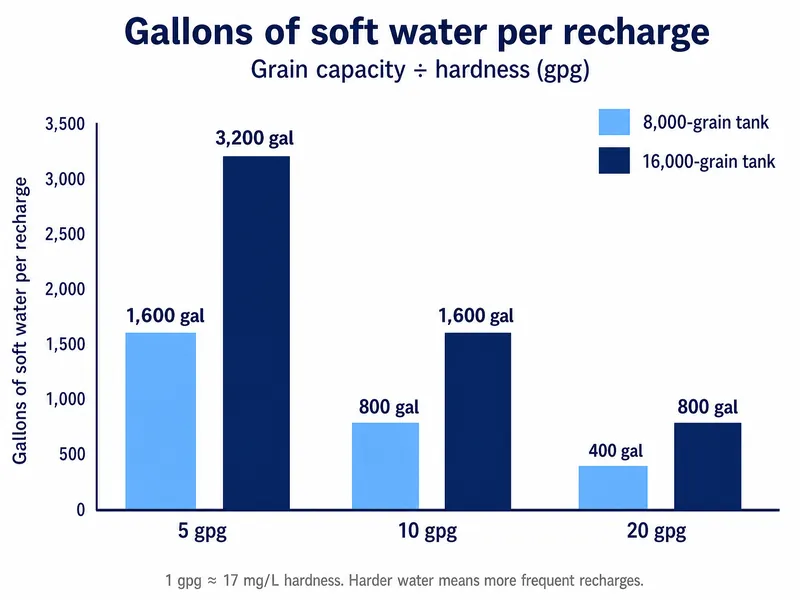
Divide the grain rating by the water's hardness in gpg. An 8,000-grain tank on 10 gpg water gives about 800 gallons, which matches QWT's listing; on 20 gpg it drops to about 400.
To turn hardness from a test strip into gpg, Penn State Extension says 1 gpg equals about 17 mg/L. Usage adds up fast: the EPA puts a standard showerhead at 2.5 gpm, so an 8-minute shower uses about 20 gallons. A couple using 40 gallons a day on 10 gpg water would get roughly 40 days from the 16,000-grain SoftPro's 1,680 gallons, and about 20 days on 20 gpg.
RV softener numbers worth knowing
- 17 mg/LHardness equal to 1 grain per gallonPenn State Extension
- 180 mg/LHardness above which water counts as very hardUSGS
- 2.5 gpmFlow of a standard showerheadU.S. EPA WaterSense
- 8 mg/LSodium added for each gpg of hardness removedNebraska Extension
How hard is campground water?
It varies with the source. The USGS classes water above 180 mg/L as very hard and links hard well water to carbonate aquifers, and the EPA WaterSense softener guide says hard water is most common in the Southwest and Midwest. A campground on city water may barely need a softener; one on a deep well may need it every day.
Test at each new site with a strip, then recharge on the gallons that number gives you. The basics of resin and recharging are in how a water softener works.
How do you recharge and store a portable softener?
Follow the seller's salt amount, then flush the brine out until the water tastes normal before reconnecting the rig. Both portables here specify table salt; the EPA's advice to avoid table salt applies to home brine tanks, not to these units.
Sodium is the other trade-off. Nebraska Extension puts the added sodium at about 8 mg/L per gpg removed, so a 15 gpg campground supply gains about 120 mg/L once softened; anyone on a low-sodium diet should keep a separate drinking supply. Our guide to drinking softened water covers the options. In cold weather, SoftPro's winterizing advice (SoftPro, a store run by our team) is to drain the unit and hoses once temperatures stay below 32°F and store it indoors.
Related guides
 GuidesWater softener salt vs potassium chloride
 GuidesHard water and your skin and hair
 GuidesIs a softener worth buying?
How we put this page together
Product facts and prices come from Quality Water Treatment's listing and the On The Go retailer listing, both checked in October 2026. General numbers come from Penn State Extension, Nebraska Extension, the USGS and the EPA WaterSense program. We did no lab work, used no forum anecdotes and left out portable brands without current published specs.
Common questions
Do RV water softeners really work?
Yes. They use the same ion-exchange resin as home softeners in a smaller tank, removing calcium and magnesium until the resin is spent. They are not built to remove iron, sulfur smell or sediment.
How often does an RV softener need recharging?
When you have used the gallons your hardness allows. On 10 gpg water QWT lists 800 gallons for its 8,000-grain model and 1,680 for the 16,000; harder water means sooner.
Does table salt work in an RV softener?
Yes, both portables here are designed for it. QWT calls for about 1 or 2 cups depending on size, and the On The Go listing calls for one or two boxes.
Which size suits a couple living full time in an RV?
The 16,000-grain size. QWT labels it for two people part time, and its larger capacity stretches the time between recharges on hard well water.
Does a portable softener reduce water pressure?
Neither seller publishes a flow rate. On The Go says its unit is built for very low pressure drop; a short inlet hose and a sediment filter ahead of the softener help keep flow up.
Is softened RV water fine to drink?
Most people can, but it carries extra sodium, about 8 mg/L per gpg removed. Keep an unsoftened drinking source if anyone aboard limits sodium, and ask a doctor before using softened water for infant formula.
Can a salt-free conditioner replace an RV softener?
Not if the goal is soft water. Nebraska Extension notes that no-salt devices do not remove hardness; they only change how it scales, and they typically need clean input water.
Our pick
SoftPro portable RV softener
Check current sizes and prices at Quality Water Treatment.
View at Quality Water Treatmentwatersofteners.reviews is run by the same team as SoftPro Water Systems and Quality Water Treatment, and we rank their products first. How we rank
Comparing options? Start with our best water softeners and reviews.